The Coffee Culture Gap Nobody Talks About
Here’s something most travel blogs won’t tell you: the vast majority of Indonesians have never tasted Kopi Luwak — and many of them find the whole concept a little strange.
Indonesia is the fourth-largest coffee producer in the world. Coffee runs through the veins of daily life here, from fishermen sipping a glass before sunrise to office workers nursing a sachet brew at their desk. But that coffee? It looks nothing like what you’ll find on a boutique café menu priced at $50 a cup.
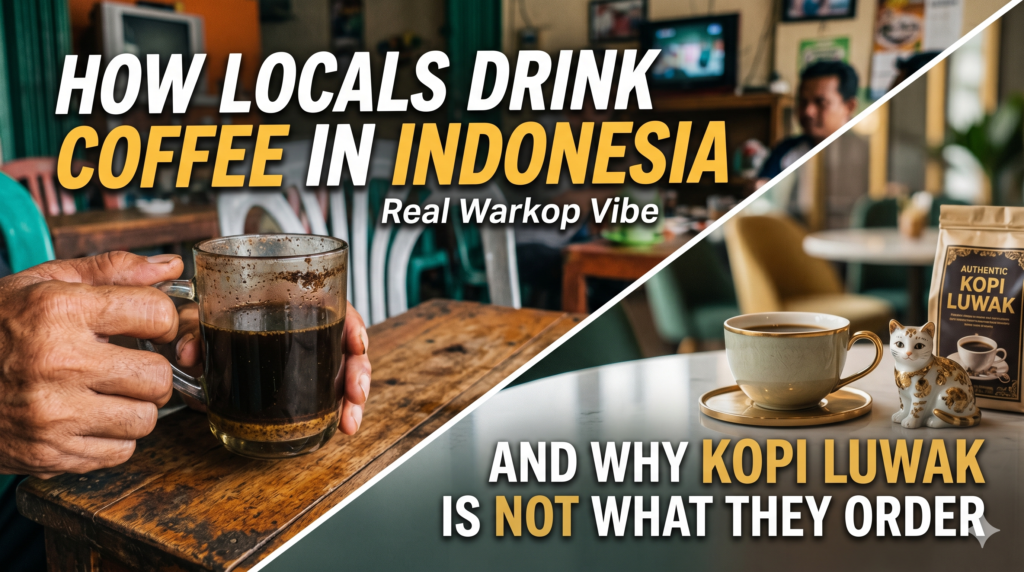
If you really want to understand Indonesian coffee culture, you need to skip the tourist brochure and walk into a warkop instead.
What Is a Warkop? (Your First Stop as a Coffee-Curious Tourist)
A warkop — short for warung kopi — is a roadside coffee stall. Think of it as Indonesia’s version of a neighborhood café, except there are no oat milk options, no jazz playlist, and absolutely no pretension.
You’ll find warkops on almost every street corner across Java, Sulawesi, Sumatra, and beyond. Plastic chairs, a small television playing the news, and a thermos of hot water permanently on the boil. This is where Indonesian coffee culture actually lives.
What to order at a warkop:
- Kopi Tubruk — The most traditional method. Coarsely ground coffee is placed directly in the glass, boiling water poured over it, and you wait for the grounds to sink before drinking. Strong, gritty, and deeply satisfying.
- Kopi Sachet — Instant coffee mixed with sugar and creamer in a small sachet. Brands like Kapal Api, Torabika, and Good Day are household names. Don’t snob it — millions of Indonesians drink this daily.
- Kopi Susu — Coffee with sweet condensed milk. Rich, creamy, and almost dessert-like.
Tip for tourists: Pull up a plastic chair, order a kopi tubruk, and just sit. Locals call this nongkrong — the art of hanging out with no agenda. It’s one of the most authentic Indonesian social rituals you can participate in, and it costs less than 50 cents.
Now, About Kopi Luwak
Yes, Kopi Luwak is real. Yes, it comes from Indonesia. And yes, it’s produced from coffee cherries that have been eaten and passed through the digestive system of the Asian palm civet (luwak in Indonesian).
The fermentation that happens inside the civet’s gut does break down proteins in the coffee bean, reportedly creating a smoother, less bitter cup. Food scientists broadly confirm that the process changes the bean’s chemistry — though whether it tastes dramatically better than a well-roasted Sumatra single-origin is genuinely debated.
The price: Authentic wild-sourced Kopi Luwak can cost $100–$600 per kilogram wholesale. In tourist cafés in Bali or Jakarta, a single cup can run $30–$80.
The problem tourists should know about: The vast majority of Kopi Luwak sold to tourists — especially in souvenir shops — comes from caged civets kept in poor conditions, not wild animals roaming freely. If ethical sourcing matters to you, ask specifically for luwak liar (wild civet) certification, and be prepared that genuinely verified wild Kopi Luwak is extremely rare.
Kopi Luwak vs. Kopi Tubruk: An Honest Comparison
| Kopi Tubruk | Kopi Luwak | |
|---|---|---|
| Price | $0.30–$1 per glass | $30–$80 per cup |
| Who drinks it | Nearly every Indonesian | Mostly tourists |
| Taste | Bold, earthy, slightly gritty | Smooth, mild, low bitterness |
| Cultural authenticity | Very high | Low (modern export product) |
| Where to find it | Any warkop | Tourist cafés, airport shops |
How to Drink Coffee Like a Local: A Quick Tourist Guide
- Find a warkop, not a café. Use Google Maps and search “warung kopi” near your location. Avoid anything with the word “artisan” in the name if you want the real experience.
- Order kopi tubruk and wait. Don’t stir aggressively — let the grounds settle naturally. Drink slowly from the top.
- Bring cash. Most warkops don’t accept cards or apps. A few thousand rupiah is all you need.
- Don’t rush. Ordering coffee at a warkop is a social act. The owner will likely want to chat. This is a feature, not a bug.
- Try regional varieties. If you’re in Aceh, order Kopi Gayo. In Toraja, ask for Kopi Toraja. In Flores, seek out Kopi Bajawa. Each region has its own distinct bean and roasting style.
Should You Try Kopi Luwak as a Tourist?
Honestly? Only if you can verify the source. If you’re in a reputable specialty coffee shop in Bali or Yogyakarta that clearly documents their sourcing and civet welfare, it’s a legitimate once-in-a-trip experience.
But if someone on the street is selling you a bag of “100% authentic wild luwak coffee” for $10? Walk away. You’re almost certainly being sold a low-quality blend with the Kopi Luwak label slapped on for tourist appeal.
The real Indonesian coffee experience costs less than a dollar and happens on a plastic chair on the side of a road. That’s the one worth having.
FAQ
Q: Is Kopi Luwak actually popular in Indonesia?
A: No. Most Indonesians have never tried it and consider it an export product aimed at foreign tourists. Local coffee culture revolves around kopi tubruk and sachet coffee.
Q: What is the best regional coffee to try in Indonesia?
A: It depends where you are. Kopi Gayo (Aceh) is famous for its clean floral notes. Kopi Toraja (Sulawesi) is earthy and full-bodied. Kopi Flores Bajawa has a chocolatey sweetness. All are world-class and cost a fraction of Kopi Luwak.
Q: Can I bring Indonesian coffee home as a souvenir?
A: Yes, and it’s one of the best souvenirs you can buy. Look for whole-bean or ground coffee from specialty roasters in Bali (Seniman Coffee), Yogyakarta, or Jakarta. Vacuum-sealed packs travel well.
Q: Is it safe to drink kopi tubruk if I have a sensitive stomach?
A: Kopi tubruk is very strong and contains fine grounds. If you have a sensitive stomach, ask for it to be made lighter (kopi tubruk kurang kental) or opt for kopi susu, which is smoother due to the milk.
Next read: [→ Why Indonesians Use Agarwood in Traditional Ceremonies — And What Tourists Should Know]