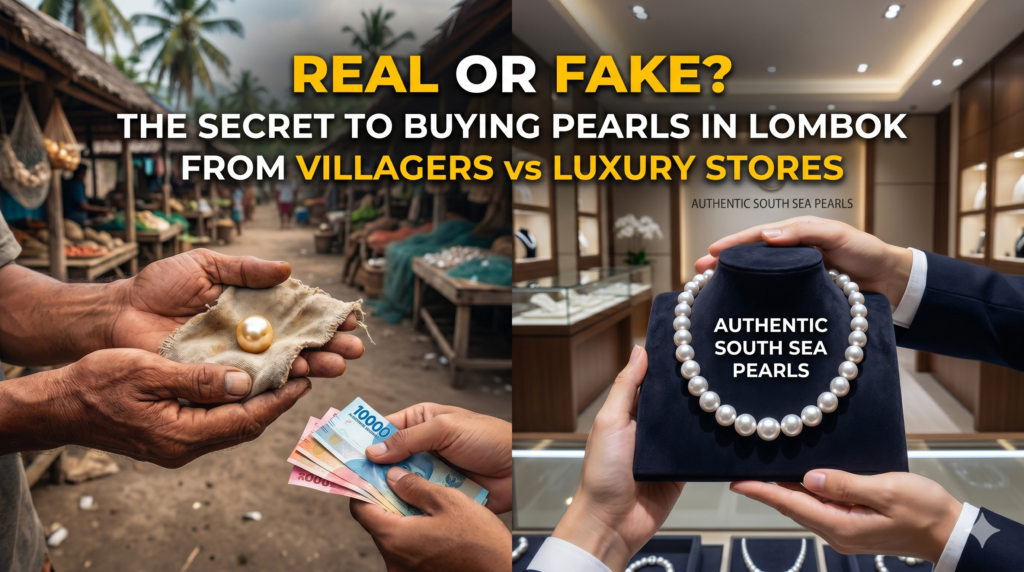
Lombok’s Best-Kept Luxury Secret
Few tourists realize that the shimmering South Sea pearls sold in high-end jewelry stores in Paris, Tokyo, and New York very likely started their journey in a modest floating farm off the coast of Lombok, Indonesia.
Lombok — and its surrounding waters near Sumbawa — produces some of the finest South Sea pearls in the world. These are the large, lustrous pearls grown in Pinctada maxima oysters, prized for their warm golden and silver-white tones and their exceptional size. A single strand can retail for tens of thousands of dollars in a luxury boutique.
But here, in the source villages? The game is completely different. And yes — tourists absolutely can buy directly from the source. You just need to know how.
Where Do Lombok’s Pearls Come From?
The main pearl farming areas in and around Lombok include:
- Sekotong Peninsula (Southwest Lombok) — home to small artisan pearl farms and local traders
- Selong Belanak area — known for quieter, less touristy pearl sellers
- Senggigi and Mataram markets — where processed and finished pearl jewelry is sold
- Gerupuk and Ekas Bay — smaller operations but accessible by local boat
The farming process takes 2–4 years per pearl. Technicians carefully nucleate the oyster, then monitor it in net cages underwater. The pearls are harvested, sorted, and graded — with top-grade pearls exported to international buyers, and lower grades sold locally or to tourists.
Can You Visit a Pearl Farm Directly?
Yes, and this is where the real experience begins.
Several pearl farms in Sekotong and the Gili islands area offer informal tours. You’ll see the oyster cages, watch a live pearl extraction if you’re lucky, and be invited into a small showroom at the end. This is not a scam — it’s just how local commerce works.
What to expect on a farm visit:
- A 20–40 minute boat ride to reach offshore farms (arrange through your guesthouse or local guide)
- A simple explanation (often in basic English) of the farming process
- An invitation to browse and buy at the end — this is expected, not pressure
Tip: You are under zero obligation to buy. Browse, ask questions, and only purchase if you genuinely love what you see.
Understanding Haggling (Tawar-Menawar) in Indonesia
Haggling is not rude in Indonesia — it is a completely normal and expected part of commerce in markets and small shops. The word for it is tawar-menawar, and it’s as natural as saying hello.
However, there are unspoken rules:
Do:
- Start your counter-offer at 40–50% of the asking price
- Stay friendly and smile throughout — this is a social exchange, not a confrontation
- Be willing to walk away genuinely; this often brings the price down
- Buy more than one item to negotiate a bundle discount
Don’t:
- Name a price you’re not willing to pay — it’s considered bad form to walk away after the seller accepts your offer
- Haggle aggressively in established fixed-price shops (look for signs that say “harga pas” — fixed price)
- Assume cheap means fake — local pricing is simply lower because overheads are lower
How to Spot Authentic South Sea Pearls vs. Fakes
This is the most important section. The Lombok market, especially in tourist areas like Senggigi, has plenty of imitation pearls sold alongside genuine ones. Here’s how to tell the difference:
The Tooth Test:
Gently rub the pearl against the edge of your front tooth. A real pearl feels slightly gritty or sandy. A fake (glass or plastic) pearl feels perfectly smooth.
The Weight Test:
Real pearls are noticeably heavier than glass or resin imitations of the same size. Hold a few and compare.
The Luster Test:
Genuine South Sea pearls have a deep, layered glow — you can almost see into the surface. Fake pearls look bright and shiny but flat, like a painted surface.
The Temperature Test:
Real pearls feel cool to the touch initially and warm slowly. Plastic fakes feel room temperature immediately.
Ask for a certificate:
Reputable sellers — especially farm showrooms — will offer a basic quality card indicating pearl size (measured in millimeters), shape, luster grade, and surface quality. This isn’t a GIA certificate, but it signals a serious seller.
What Should You Pay? A Rough Price Guide
Prices vary enormously based on pearl size, shape, luster, and surface quality. Here’s a general tourist reference:
| Type | Market Price (Loose Pearl) | Fair Tourist Price |
|---|---|---|
| Small round (7–8mm) | Rp 150,000–300,000 | Rp 200,000–350,000 |
| Medium round (9–10mm) | Rp 400,000–900,000 | Rp 500,000–1,000,000 |
| Large round (11–13mm) | Rp 1,500,000–4,000,000 | Rp 1,800,000–4,500,000 |
| Full necklace strand | Rp 3,000,000–15,000,000+ | Negotiate hard |
Note: “Fair tourist price” means you’ve haggled reasonably and paid a slight premium — which is fine and expected.
Practical Tips Before You Go
- Bring cash (Rupiah). Most village sellers and farm shops don’t accept cards.
- Go in the morning. Sellers are in better moods, less tired, and more willing to negotiate.
- Don’t arrive in a tour group bus. Prices immediately inflate. Go independently or with a local guide.
- Take photos of what you buy. For insurance purposes and for customs if you’re carrying high-value jewelry.
- Check your country’s customs rules. Many countries allow personal jewelry imports duty-free up to a certain value — know your limit before you buy big.
FAQ
Q: Is it legal to bring South Sea pearls home from Indonesia?
A: Yes. Pearls are not a restricted export item. However, check your home country’s customs import value limits to avoid surprise duties.
Q: Are the pearls in Senggigi market real?
A: A mix. Some are genuine cultured South Sea pearls, others are freshwater pearls (smaller, cheaper), and some are glass imitations. Always use the tooth test and buy from sellers who can explain their product clearly.
Q: What’s the difference between South Sea pearls and freshwater pearls?
A: South Sea pearls (from Pinctada maxima oysters) are larger, rarer, and more lustrous. Freshwater pearls are smaller and much cheaper. Both are real pearls — the difference is origin, size, and value.
Q: Can I get a pearl set into a ring or pendant in Lombok?
A: Yes. Many jewelers in Mataram and Senggigi offer same-day or next-day setting services at very reasonable prices. Bring your pearl and discuss your design.
Next read: [→ Why Indonesians Use Agarwood in Traditional Ceremonies — And What Tourists Should Know]