In 2018, a study published in the journal Cell stopped biologists in their tracks.
A specific group of people in Indonesia had evolved — over generations, through natural selection — spleens significantly larger than those of any other human population on earth. The Bajau people’s spleens were on average 50% larger than those of their land-dwelling neighbors.
This is not a minor anatomical variation. The spleen contracts during a dive and releases oxygenated red blood cells into the bloodstream, extending the time a person can hold their breath. A larger spleen means more oxygen reserve. More oxygen reserve means longer, deeper dives — repeatedly, every day, for an entire working life.
The Bajau didn’t develop this by training. They developed it by being, for thousands of years, a people who live on and in the sea. Generation after generation. Until the genetic variants that support diving physiology became fixed in their population.
They are the only known human group to have undergone measurable evolutionary adaptation for an aquatic lifestyle.
Who the Bajau Are
The Bajau — also written Bajo, Badjao, Badjau — are a maritime ethnic group whose traditional territory spans the Sulu Sea and the Sulawesi Sea: an enormous stretch of water covering parts of Indonesia, Malaysia, and the Philippines.
In Indonesia, Bajau communities are found primarily in the waters around Sulawesi, Kalimantan, and the eastern archipelago.
The Bajau have historically been sea nomads. Their home was not on land. It was on boats — wooden vessels called lepa-lepa on which entire families lived year-round, moving continuously through their maritime territory, fishing, diving, trading. They came ashore rarely and briefly, for water or specific trade goods. Many Bajau spent their entire lives without sleeping on solid ground.
This is not ancient history. It is the living memory of families alive today.
The Floating Villages of Sulawesi
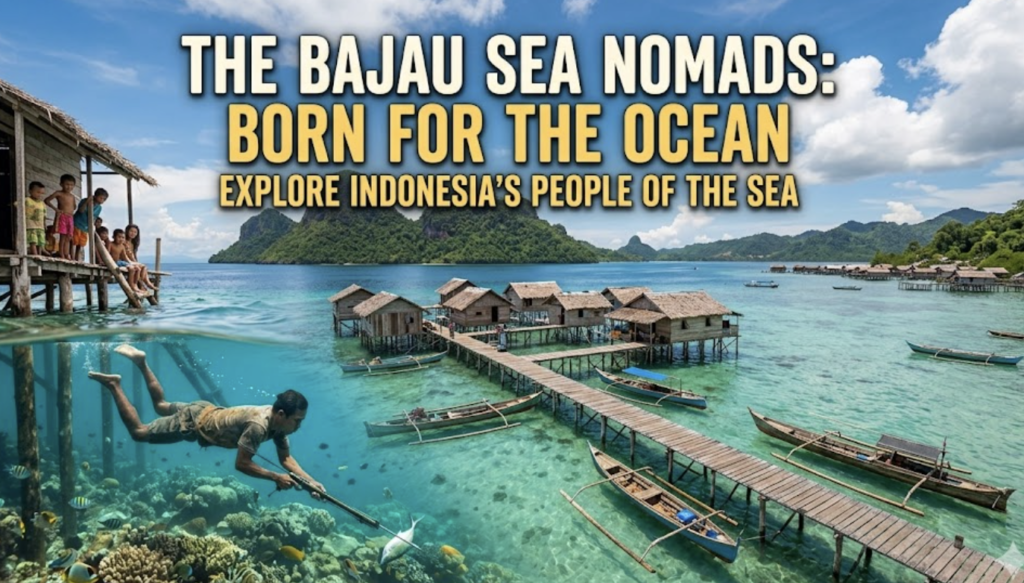
Most Bajau communities in Indonesia today have transitioned from open-ocean boat life to stilt villages — wooden houses built directly over the water on stilts driven into the seabed, connected by narrow walkways that function as streets.
Torosiaje village in Gorontalo, North Sulawesi, is one of the most intact of these communities — an entire village built on a reef flat, accessible only by boat, with no land component whatsoever. Children play on the walkways. Women clean fish above open water. Men come and go in small boats. The village exists in a relationship with the sea that is total, not metaphorical.
The walkways connect houses, a mosque platform, small market spaces. An entire neighborhood, suspended.
How Bajau Divers Work
Traditional Bajau divers free-dive — single breath, no equipment. They reach depths of 60–70 meters. They remain underwater for several minutes at a time. They do this repeatedly throughout a working day that can last eight hours.
For comparison: the world record for competitive free diving is around 214 meters under optimal conditions with professional coaching. Bajau divers achieve 60–70 meters while spearing fish, harvesting sea cucumbers, and retrieving objects from the bottom — as a job, not as a sport.
The tools are simple. Wooden goggles with glass lenses. A weight belt. A spear powered by rubber-band tension. The knowledge — of currents, fish behavior, depth limits for a specific person on a specific day — is complex, accumulated, and transmitted entirely through practice and oral teaching.
Many Bajau deliberately rupture their eardrums in childhood to equalize pressure more easily at depth. Permanent mild hearing loss, accepted as the cost of a lifetime of unimpeded diving.
The Sea as a Living World
For the Bajau, the ocean is not a resource. It is a world — with its own social structure, spiritual inhabitants, and rules of relationship that must be maintained.
Traditional Bajau belief involves specific relationships with sea spirits inhabiting particular reef formations, current systems, and deep-water areas. Before a fishing expedition, prayers are offered. Certain areas are off-limits at certain times. Certain species are never taken from certain locations. These restrictions encode generations of empirical observation about which places need rest to remain productive — expressed in the language of spiritual prohibition because that is the language that makes communities comply across generations.
The sando — the Bajau shamanic figure, the mediator between the human community and the sea — advises on conditions, resolves conflicts with spiritual forces, and performs healing rituals. As Islam has spread through Bajau communities, this role has diminished. The relationship with the sea it managed has not.
What the Bajau Face Now
The Bajau’s situation carries a painful irony.
The traditional lifestyle that produced their extraordinary physiology — that made them, biologically speaking, the most ocean-adapted humans alive — is increasingly unsustainable. Blast fishing and cyanide fishing have destroyed the reef systems their diving depends on. Marine protected areas, ecologically necessary, sometimes restrict Bajau fishing rights without recognizing their prior claim to those waters.
Many Bajau face statelessness. Their ancestors moved continuously across national borders that were drawn centuries after the Bajau maritime territory was established. Many lack citizenship documentation in any country. Healthcare, education, legal protection — access to all of it requires documentation that history never gave them.
FAQ
Q: Is the Bajau’s larger spleen present from birth? A: Research suggests it is largely genetic — present even in Bajau individuals who do not regularly dive, which indicates an evolved trait rather than an acquired one. Diving training from childhood likely reinforces it, but the biological advantage appears to exist before it is ever used.
Q: Can tourists visit Bajau stilt villages? A: Some communities receive visitors, particularly in the Wakatobi National Park area of Southeast Sulawesi. Go with a local guide. Ask permission before photographing people or homes. Buy fish or crafts directly from community members if you want to support them in a meaningful way.
Q: Do Bajau people still live as full sea nomads? A: Pure nomadic boat-living Bajau are rare now. Most communities have settled into stilt villages. Some families in remote parts of Sulawesi and the Sulu archipelago still maintain semi-nomadic patterns — extended time on the water, returning to land bases periodically.
Next read: → Why Does Indonesia Have a Lake That Turns Blood Red? The Science Behind Lake Kelimutu