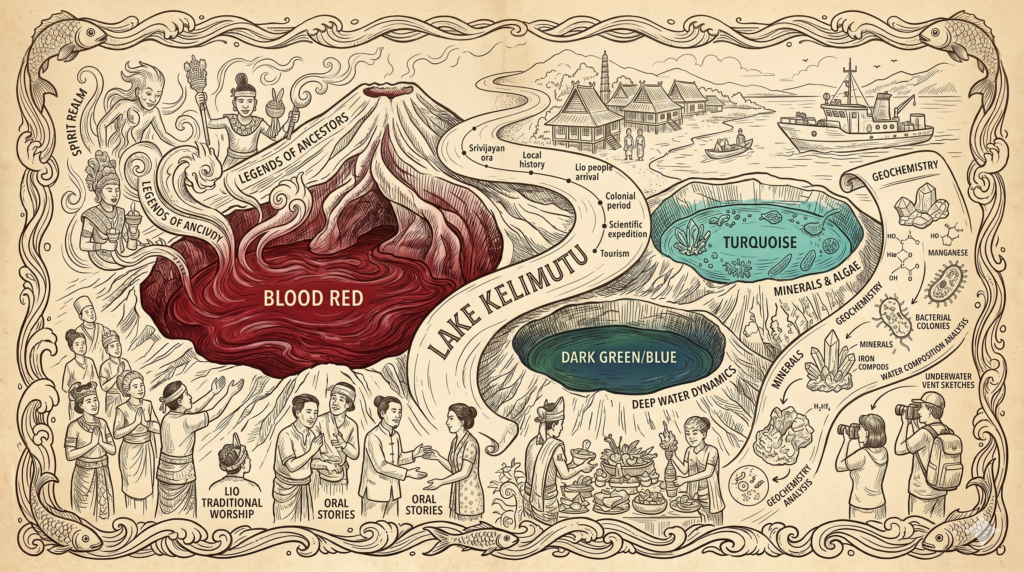
On the summit of an active volcano on the island of Flores, there are three lakes sitting in three separate craters — so close to each other that you can see all of them from a single viewpoint. They should look identical. Same altitude, same geology, same rainfall, same volcanic activity beneath them.
They don’t look identical at all.
One might be a deep turquoise blue. Another could be a murky chocolate brown. The third might be black, or green, or — on the days that make photographs go viral and locals go quiet — a dark, unsettling red, the color of old blood.
And none of these colors stay the same. They shift. Sometimes gradually over months. Sometimes dramatically overnight. A lake that was vivid teal last Tuesday can be black by Friday, with no warning and no obvious cause.
This is Lake Kelimutu. And the local Lio people of Flores have known for generations what these color changes mean.
They are the moods of the dead.
Where Is Lake Kelimutu and How Do You Get There?
Lake Kelimutu sits at the summit of Gunung Kelimutu — an active stratovolcano rising 1,639 meters above sea level in Ende Regency, central Flores, East Nusa Tenggara. The nearest town is Moni, a small village about 13 km from the summit, which serves as the base for most visitors.
Getting to Kelimutu requires effort — and that effort is entirely worth it.
Flores is reached by flying into Ende Airport (ENE) or Komodo Airport in Labuan Bajo, then traveling overland. From Ende to Moni takes about 2.5 hours by car. From Labuan Bajo, Moni is approximately 6–8 hours along the Trans-Flores Highway — a winding mountain road that is stunning and exhausting in equal measure.
The summit is accessible by road to within about 1.5 km of the crater rim, followed by a short walk. Most visitors make the pre-dawn ascent to catch sunrise over the lakes — the light at that hour, combined with the possibility of mist in the valleys below and the lakes shifting colors in the early light, is among the most extraordinary natural sights in Indonesia.
The Three Lakes and Their Names
The three crater lakes of Kelimutu each have their own name, their own spiritual identity, and their own distinct behavior.
Tiwu Ata Mbupu — “Lake of Old People” or “Lake of Elderly Spirits.” This is the westernmost crater, separated from the other two by a ridge. It tends toward deep blue or blue-green and is generally considered the most stable of the three in terms of color change — though it has shifted dramatically at various points in recorded history.
Tiwu Ko’o Fai Nuwa Muri — “Lake of Young Men and Maidens.” This is the middle crater of the eastern pair. It is perhaps the most visually dramatic, capable of shifting through turquoise, green, brown, and black. It is believed to be the resting place of the souls of young people who died in the prime of life.
Tiwu Ata Polo — “Lake of Wicked People” or “Lake of Evil Spirits.” This is the easternmost crater, sharing a rim with the middle lake. It is the one most associated with dramatic color shifts toward red and brown — and it carries the darkest spiritual associations in Lio tradition. Souls of those who lived badly, who committed crimes or betrayed their communities, are believed to rest here.
What the Lio People Believe
For the indigenous Lio people of central Flores, Kelimutu is not a geological curiosity. It is the final destination of every human soul — a literal afterlife, visible and present in the landscape.
When a person dies, their soul is understood to travel to Kelimutu and enter the lake appropriate to their life. The elderly enter Tiwu Ata Mbupu. The young enter Tiwu Ko’o Fai Nuwa Muri. Those who lived poorly — the selfish, the violent, the dishonest — enter Tiwu Ata Polo.
This is not mythology in the distant, abstract sense. It is understood as physical reality. The lakes are where your grandmother is right now. They are where you will go.
The color changes are not random in the Lio worldview. They are communications — signals of activity in the spirit world. When a lake turns dramatically red or black, it is understood as a sign of disturbance among the souls within it, or as a warning to the living community about something that requires attention. Village elders and spiritual leaders (mosalaki) watch the lakes’ behavior carefully, particularly before important community events.
Every year, the Lio community performs a ceremony at Kelimutu called Pati Ka Du’a Bapu Ata Mata — an offering ritual in which food, flowers, and prayers are brought to the crater rim and offered to the souls of the ancestors resting in the lakes below. It is an act of remembrance and connection — the living feeding the dead, maintaining the relationship across the boundary between worlds.
What Science Says: The Real Explanation for the Color Changes
The scientific explanation for Kelimutu’s color-shifting lakes is fascinating in its own right — and does not actually diminish the mystery as much as you might expect.
Volcanic Chemistry
Kelimutu’s lakes are crater lakes sitting directly above an active hydrothermal system. Volcanic gases — primarily sulfur dioxide, hydrogen sulfide, and carbon dioxide — vent continuously from fumaroles beneath the lake beds and dissolve into the water. The resulting chemistry is extraordinarily complex and unstable.
The color of each lake at any given time is determined by the interaction of several variables: the concentration of dissolved minerals (particularly iron, sulfur, and manganese compounds), the pH level of the water, the activity level of the hydrothermal vents, the presence or absence of specific microbial communities, and the angle and quality of light.
When volcanic activity increases, new gases and minerals enter the lake, shifting its chemical balance and therefore its color. When activity decreases, the lake chemistry stabilizes and may shift toward different equilibrium colors.
Why the Three Lakes Are Different Colors Simultaneously
This is the part that genuinely puzzles visitors. Three lakes, same volcano, same general geology — why would they be different colors at the same time?
The answer lies in the fact that each crater has its own isolated hydrothermal system beneath it. The vents feeding each lake produce slightly different gas and mineral compositions, operate at different temperatures and pressures, and respond to subsurface geological changes independently of each other. The two eastern craters (Tiwu Ko’o Fai and Tiwu Ata Polo) are physically closer and share some geological features, which is why they tend to shift in loose correlation — but even they can be dramatically different from each other.
The Red Color: What Causes It?
The blood-red color that appears periodically in Tiwu Ata Polo is caused by an increase in dissolved iron compounds — specifically iron oxides — combined with specific sulfur chemistry conditions. When hydrothermal activity increases and pushes iron-rich water from depth into the lake, combined with the right pH conditions, the lake shifts toward red and brown tones.
This is the same basic chemistry that creates red-colored hot springs in volcanic areas worldwide — but the scale and drama of a full crater lake turning red makes Kelimutu’s version uniquely striking.
Visiting Kelimutu: What to Expect
Sunrise Is Worth the Alarm Clock
The standard advice is to depart Moni by 4:00–4:30 AM to reach the summit for sunrise. This is correct. The pre-dawn ascent in the dark, the gradual lightening of the sky, the moment the lakes emerge from darkness into the first light — this sequence of experiences is what makes Kelimutu extraordinary rather than merely beautiful.
Bring warm layers. The summit at 1,600 meters before dawn is significantly colder than coastal Flores, and the wind at the crater rim can be biting.
Respect the Spiritual Significance
Kelimutu is not just a natural attraction. It is a sacred site for the Lio people. Walking along the crater rim, do so quietly and respectfully. Do not shout across the craters. Do not throw anything into the lakes — this is both ecologically harmful and deeply offensive to the local community, for whom the lakes are literally where their ancestors rest.
If you encounter Lio community members performing rituals or leaving offerings at the crater rim, maintain a respectful distance and do not photograph without asking.
There Is No Swimming
The lakes are acidic, volcanically active, and spiritually off-limits. This is not a situation where the prohibition needs much justification.
FAQ
Q: Can the color of Kelimutu’s lakes be predicted?
A: No. Scientists who study the lakes can identify patterns — certain seasons or periods of increased volcanic activity tend to correlate with more dramatic color shifts — but specific color changes cannot be predicted in advance. This unpredictability is part of what makes Kelimutu so compelling.
Q: Are the lakes safe to walk near?
A: Yes, along the designated paths and viewing areas. The crater rims are stable and well-maintained. The main risks are altitude (bring water and take the climb slowly if you’re not acclimatized) and the cold at sunrise. The volcanic gases are not a significant hazard at the crater rim distance from the lake surface.
Q: What colors have the lakes been historically?
A: The documented range across the three lakes includes turquoise, teal, blue, green, black, brown, dark red, and white. The most dramatic documented shift was in 1992, when one of the eastern lakes turned a vivid blood red — a color that has recurred several times since. Photographs of the lakes from different years show a remarkable range.
Q: Is there accommodation in Moni?
A: Yes. Moni has a range of guesthouses catering to Kelimutu visitors, from very basic to comfortable mid-range options. Book in advance during the July–August peak tourist season. The village itself is charming — surrounded by rice paddies and volcanic hills — and worth spending a full day in, not just passing through.
Next read: [→ The Pink Beach of Komodo: Why Is the Sand Actually Red?]