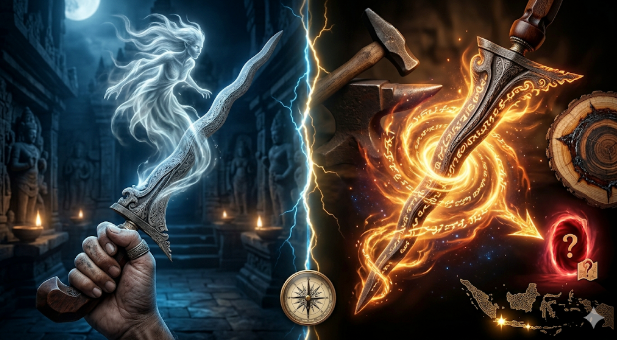
There is a dagger sitting in a wooden box in a house in Central Java right now. It has a name. It has a personality. It has dietary preferences — certain foods are placed near it during specific nights of the Javanese calendar. The family that owns it consults it before making major decisions. When a family member is ill, it is one of the first things they think to check: has the kris been neglected? Has someone in the household offended it?
The kris is not a weapon. It stopped being primarily a weapon centuries ago. It is a living member of the family — and if you want to understand Javanese culture at its deepest level, you need to understand why.
What Is a Kris?
A kris (also spelled keris) is a distinctive asymmetrical dagger originating in the Indonesian archipelago, most deeply associated with Javanese, Balinese, and Malay cultures. Its most recognizable feature is the blade — which may be straight or winding in a series of curves called luk. A blade with three curves is a 3-luk kris. A blade with seven curves is a 7-luk kris. The number of luk is not decorative — each number carries specific spiritual associations and energetic properties.
In 2005, UNESCO proclaimed the kris an Intangible Cultural Heritage of Humanity — recognizing not just the extraordinary craftsmanship involved in its creation, but the entire philosophical and spiritual system encoded within it.
The kris has been present in Indonesian life for at least a thousand years. It appears in the stone reliefs of 14th-century Majapahit temples. It was the weapon of choice for aristocrats, warriors, and kings. It traveled with Indonesian sailors across the maritime trade routes, appearing in historical records from the Philippines to Madagascar.
But its importance was never purely martial. From the very beginning, the kris was understood to be something more than a cutting tool. It was a vessel.
The Empu: The Man Who Makes a Living Weapon
To understand why a kris is considered alive, you need to understand how it is made — and who makes it.
A kris is forged by a master smith called an empu. This is not merely a skilled metalworker. An empu is a spiritual practitioner whose entire life is oriented around the ability to imbue metal with supernatural power.
The forging of a kris is a ritual act as much as a craft one. Before beginning, the empu fasts, meditates, and undergoes purification rituals that may last days or weeks. The specific timing of the forging — the day, the hour, the phase of the moon — is calculated according to the Javanese calendar to align with auspicious energetic conditions. Prayers are recited continuously throughout the forging process.
The materials used are themselves spiritually significant. Traditional kris blades are made from a folded combination of iron and nickel-iron meteorite (pamor) — metal that fell from the sky, carrying cosmic energy. The folding and welding of these metals during forging creates the distinctive patterned surface of the blade, called pamor, which forms naturally through the process and is read for its spiritual meaning like a message written in metal.
Different pamor patterns carry different powers: some attract wealth, some offer protection, some enhance the owner’s authority, some bring luck in love. The empu reads the emerging pamor pattern as the blade forms and adjusts the spiritual intention of the forging accordingly.
When the kris is complete, it is not simply a finished object. It is understood to house a spiritual presence — called dhanyang or isi in Javanese — that was drawn into the blade through the combined intention of the empu’s spiritual work and the cosmic conditions of the forging. This presence is what makes the kris alive.
Why Every Kris Has a Personality
Ask a Javanese family about their heirloom kris and they will not describe it the way you’d describe a piece of furniture or a tool. They will describe it the way you’d describe a person.
“This kris is temperamental — it doesn’t like to be touched by people with bad intentions.”
“Our kris has always brought good fortune to businessmen in the family, but it caused problems for my grandfather when he tried to use it during a dispute — it wasn’t the right situation for it.”
“We call this one Ki Setra. It’s the eldest. It’s been in the family for seven generations.”
These descriptions reflect a genuine belief, shared across Javanese culture at all levels of education and modernity, that each kris has its own character — determined by the empu who made it, the spiritual conditions of its forging, the pamor pattern of its blade, and the accumulated history of every owner it has passed through.
A kris that has been owned by a powerful, virtuous person for many years absorbs that person’s spiritual energy. A kris that has been involved in violence carries the residue of that violence. This is why buying an antique kris from a market stall without knowing its history is considered risky — you may be bringing home something with an attached spiritual history you know nothing about.
The Malam Jumat Kliwon: Feeding Night
The most important night in the Javanese kris calendar is Malam Jumat Kliwon — the intersection of Friday (Jumat in Indonesian) with the Kliwon day in the five-day Javanese Pasaran cycle. This convergence happens roughly every 35 days and is considered the most spiritually potent night of the calendar.
On Malam Jumat Kliwon, families with heirloom kris perform a ritual of acknowledgment and care. The kris is removed from its storage, unwrapped from its cloth, and cleaned — typically with specific fragrances including lime juice, rose water, and sometimes agarwood smoke. Fresh flowers are placed near it. Sometimes small food offerings are arranged alongside it.
This is not superstition performed out of habit. It is understood as a relational act — the living presence within the kris needs to be acknowledged, respected, and nourished, just as a family elder needs to be visited and honored.
Neglecting a kris on Malam Jumat Kliwon is considered spiritually dangerous — not because the kris will “do” something in retaliation, but because neglect disrupts the relationship between the family and the protective spiritual force the kris represents. When that relationship weakens, the family loses the kris’s protection.
The Kris as a Diplomatic and Social Object
Beyond its spiritual role in family life, the kris has historically been one of the most important social and diplomatic objects in Javanese and Malay culture.
A kris given as a gift between rulers was a transfer of spiritual alliance — not just a symbol of friendship, but an actual exchange of protective spiritual force. A kris sent in a ruler’s place to represent him at a ceremony carried his spiritual authority and was treated as his actual presence.
A man’s kris was inseparable from his social identity. The quality of his kris, its pamor pattern, its handle material, and its sheath decoration announced his rank, his spiritual standing, and his family lineage to anyone who knew how to read these signals — which, in traditional Javanese society, everyone did.
Removing a man’s kris without permission was an act of profound violation — not just disarmament, but a stripping of spiritual identity. In historical Javanese courts, the way a man wore his kris (inserted into the back of his waistband, angled to the right or left) communicated specific information about his status and intentions.
The Kris Today: Still Alive
The kris has not become a museum piece in Indonesia. It remains a living object in Javanese, Balinese, and Malay cultural life.
In Central Java, traditional Javanese weddings still feature the groom wearing a kris as part of his formal attire — inserted into the back of his batik waistband in the traditional manner. This is not costume. It is the continuation of a cultural practice that has run unbroken for centuries.
In Bali, the kris plays a central role in the famous Kris Dance (Tari Kris) — a ritual performance in which male dancers enter a trance state and attempt to stab themselves with kris blades. Those who are in genuine trance are understood to be protected by the spiritual force within the kris, which prevents the blade from penetrating the skin. This is not a performance trick. It is a ritual test of the relationship between dancer and spiritual force — and it is taken with complete seriousness by participants and Balinese Hindu priests alike.
Across Indonesia, there are still practicing empu — though their numbers are dwindling. The most respected empu work in Central Java, particularly in the Yogyakarta and Solo areas, and their finest work commands extraordinary prices from collectors and families seeking a kris with genuine spiritual provenance.
What Tourists Should Know
If you are offered a chance to handle a family’s heirloom kris, treat it as you would treat holding someone’s infant child — with both hands, with care, with awareness that you are holding something they love and that carries weight beyond the physical.
Ask before touching. Never point a kris at anyone, even jokingly. Do not mock the beliefs attached to it. And if a family member seems reluctant to let you handle it, respect that reluctance — some kris are understood to react badly to contact with strangers whose spiritual condition they don’t recognize.
Buying a kris as a souvenir is entirely possible — there are legal antique and craft kris available throughout Java and Bali. A craft kris made by a modern smith without the full spiritual forging ritual is a beautiful object and a meaningful souvenir. Just understand that it is a different category of object from a heirloom kris with genuine spiritual history — and the families who own those rarely sell them.
FAQ
Q: Is it safe to buy an antique kris in Indonesia?
A: From a legal standpoint, yes — antique kris are not restricted export items. From a cultural standpoint, Javanese tradition cautions that buying a kris without knowing its history means you may be acquiring an object with an attached spiritual history you don’t understand. Most serious collectors have their acquired kris spiritually assessed by a trusted empu or spiritual advisor before keeping them in the home.
Q: What is the correct way to store a kris?
A: Traditionally, a kris is stored wrapped in cloth — often black velvet or traditional batik — and placed in a specific location in the home, sometimes elevated, never on the floor. It should be cleaned and treated with oil periodically to prevent rust on the blade. On Malam Jumat Kliwon, it should be acknowledged with flowers and fragrance.
Q: Can women own a kris?
A: Yes. While the kris is most associated with male identity in historical Javanese culture, women have owned and inherited kris throughout history. Some kris are specifically associated with feminine spiritual energy and are passed through the maternal line.
Q: Where is the best place to see kris in Indonesia?
A: The Kraton (royal palace) museums in Yogyakarta and Solo both have extensive kris collections with English explanations. The National Museum in Jakarta holds important historical examples. For living kris culture, attending a traditional Javanese wedding or visiting a market during Malam Jumat Kliwon in Solo or Yogyakarta will give you a sense of how the kris functions in contemporary life.