
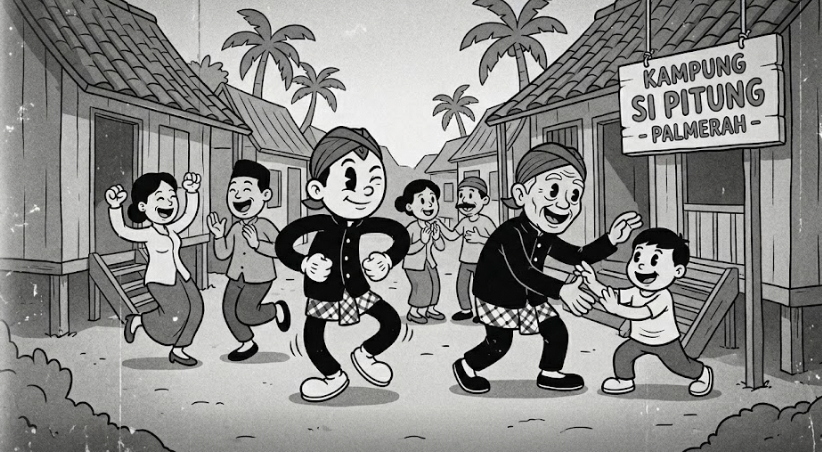
There is a stretch of West Jakarta — bounded roughly by Slipi to the north and Kebon Jeruk to the south — that most Jakartans drive through without ever looking at.
It is called Palmerah. The road through it is one of the busiest commuter arteries in the city. The neighborhoods on either side of that road are something else entirely.
They are where the original Betawi of Jakarta still live.
The Neighborhood That Made Si Pitung
In 1866, in a kampung called Rawa Belong inside what is now Palmerah subdistrict, a child was born who would become the most famous folk hero in Jakarta’s history.
His name was Si Pitung. The colonial Dutch called him a bandit. The Betawi called him something closer to a Robin Hood — a jawara who robbed the wealthy, humiliated the colonial police force, and whose silat skills were said to be so refined that bullets could not touch him.
The historical Si Pitung was killed by the Dutch in the 1890s. The mythological Si Pitung never died. He became the patron figure of an entire martial art lineage — Cingkrik silat — that traces its origin to the same Rawa Belong neighborhood where he was born.
Cingkrik is still practiced in Palmerah today. Not in a sanitized cultural center for tourists. In the actual courtyards of actual families, by actual grandfathers teaching actual grandchildren.
What “Original Betawi” Actually Means
There is a deeply uncomfortable historical fact about Betawi identity that Melawan Lupa — Metro TV’s long-running history program — has spent multiple episodes trying to unpack across its “Siapakah Penduduk Asli Jakarta?” series.
The Betawi were never the original inhabitants of Jakarta. They were the result of Jakarta. A blended people — Malay, Sundanese, Javanese, Balinese, Bugis, Arab, Chinese, Portuguese, Dutch — who fused into a single ethnic identity inside the city walls of Batavia over four centuries.
In other words: the Betawi are what happens when an entire global trading port becomes a culture.
This matters for Palmerah. Because if you accept that Betawi identity was always a blend, then “original Betawi” does not mean genetic purity. It means the families who stayed when the property prices made everyone else leave.
Palmerah is one of the few subdistricts in West Jakarta where those families still constitute a recognizable community.
Inside Kampung Betawi Kemanggisan
In RW 06 Kemanggisan, inside Palmerah subdistrict, there is a designated cultural site called Kampung Betawi. There is a gapura at the entrance. There are miniature ondel-ondel statues. There is signage explaining gigi balang ornament patterns. To a casual visitor, it looks like a thematic kampung built for show.
It is not.
The reason Kampung Betawi Kemanggisan exists is because the families who live in RW 06 — organized as the Keluarga Betawi Palmerah dan Sekitarnya, or KBPS — decided their neighborhood was going to keep being Betawi whether the rest of West Jakarta did or not. The ornamentation came later. The community was already there.
This is the part that gets lost when Jakarta’s cultural sites are reduced to tourist destinations. The kampung is not a museum. It is where people live. The Betawi-language wedding ceremonies, the Lebaran traditions with rice cakes wrapped in palm leaves, the lenong theater performed in the gang on selamatan nights — all of that is still happening, not as performance, but as the texture of a normal weekend.
Why You Have Never Heard of It
Palmerah does not show up on tourist maps for the same reason most genuine neighborhoods do not show up on tourist maps. There is nothing to sell.
There is no signature dish marketed to outsiders. There is no curated walking tour. The most famous resident in the neighborhood’s history died 130 years ago and was technically a criminal. The community that protects his legacy is not trying to convert it into a brand.
Which is, of course, exactly why it survived.
Palmerah remains Betawi because Palmerah was never interesting enough to gentrify. The land prices in West Jakarta stayed lower than in Pondok Indah or Menteng. The old families could afford to keep their compounds. The grandchildren could afford to stay in walking distance of their grandparents. The cultural transmission that breaks in three generations when families scatter across the metro area — that did not break here.
For now.
The MRT expansion routes are getting closer. The property developers know the neighborhood exists. Whether Palmerah remains what it is for another twenty years is a question nobody in Kemanggisan particularly wants to answer.
FAQ
Q: Is Palmerah safe to visit, and how would I actually see the Betawi community there?
Palmerah is a normal working-class West Jakarta subdistrict. It is safe in the ordinary sense — no more dangerous than any other dense Jakarta neighborhood. What it is not is set up for tourists. The Kampung Betawi at RW 06 Kemanggisan is the most accessible entry point — there is signage, the gapura is visible from Jalan Kemanggisan Utara, and the local community organization (KBPS) hosts cultural events that outsiders are welcome to attend. The festival calendar tends to cluster around Lebaran, Idul Adha, and Jakarta’s anniversary in June. Outside those moments, the neighborhood is just a neighborhood — which is the entire point.
Q: What is Cingkrik silat, and can it actually still be learned in Palmerah?
Cingkrik is one of the major Betawi silat lineages, traditionally traced to the same Rawa Belong neighborhood that produced Si Pitung. It is characterized by close-quarter movement, low stances, and an emphasis on practical street self-defense rather than ceremonial display. It is still taught, mostly through informal teacher-student arrangements rather than formal academies. Anyone genuinely interested can find practitioners through the Betawi cultural organizations in Palmerah — but it is not something you can sign up for on an app.
Q: Why is Palmerah more authentically Betawi than other Jakarta neighborhoods?
It mostly comes down to who could afford to stay. The Betawi of central Jakarta were pushed out of Menteng and Kebayoran by colonial planning and post-colonial gentrification. The Betawi of South Jakarta were displaced by the elite residential development of the 1970s and 1980s. The neighborhoods where Betawi families could keep their land across generations were the ones where the land never became valuable enough to be worth selling. Palmerah was one of those places.
Next read: → Kebon Jeruk: Finding the Orang Asli Jakarta Behind the Media Towers