Here is what we know about the greatest empire Southeast Asia has ever produced:
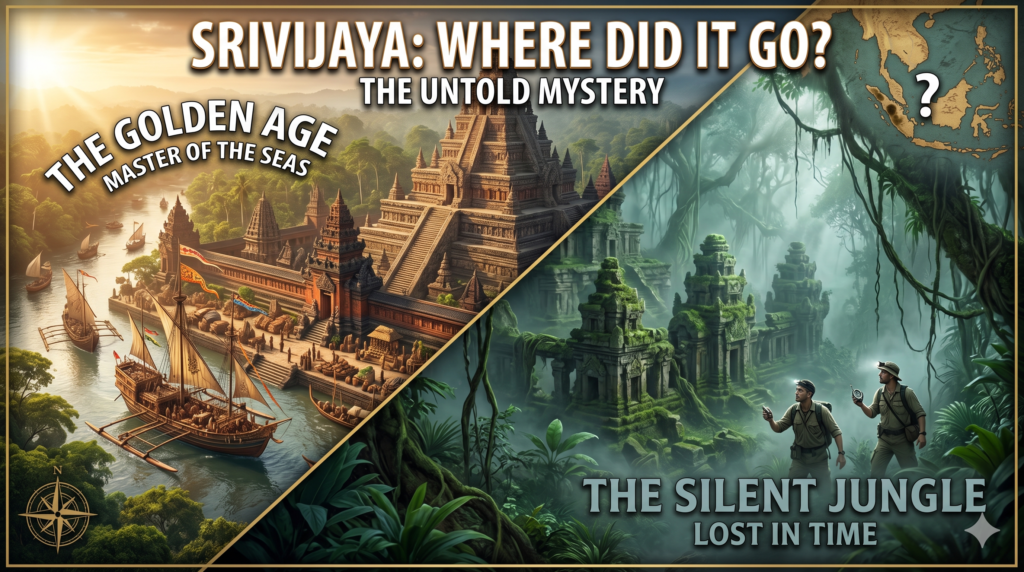
At its peak, it controlled every major sea lane between China and India. Its navy was the most feared in the eastern ocean. Its capital was a city of such wealth that Arab traders wrote about it in stunned disbelief — a place where the king threw gold ingots into the harbor every morning as an offering to the sea, and where the treasury was so vast that even this daily extravagance barely registered as a gesture.
For six hundred years, roughly from the 7th to the 13th century, the Kingdom of Srivijaya was the dominant power of maritime Asia. Every ship that carried silk from China to the spice ports of India passed through waters that Srivijaya controlled. Every Buddhist monk traveling from India to study in China stopped at Srivijaya first — because it was the most important center of Buddhist learning in the world outside of India itself.
And then it was gone.
Not conquered dramatically. Not burned to the ground in a single catastrophic defeat. It just… dissolved. Slowly, quietly, over decades — until the name Srivijaya faded from the living memory of the region it had once dominated, and was remembered only in the dusty manuscripts of Chinese imperial archives and the stone inscriptions of a dozen scattered sites across Sumatra and the Malay Peninsula.
For more than six centuries after its disappearance, the Western world didn’t even know it had existed.
What Is Srivijaya? The Empire the History Books Forgot
In 1918, a French scholar named George Coedès was working through a collection of old inscriptions from Sumatra when he encountered a word that kept appearing across multiple texts from multiple centuries: Srivijaya. Not a person’s name. Not a title. A place. A kingdom.
Coedès realized, with growing astonishment, that he was looking at evidence of an enormous and long-forgotten empire — one that had dominated Southeast Asian history for half a millennium and had been completely erased from the Western historical record.
His 1918 paper announcing the discovery of Srivijaya caused a minor earthquake in the academic world. How had something this large been invisible for so long?
The answer, as it turns out, reveals something fundamental about what kind of civilization Srivijaya was — and why finding it is still, more than a century later, an unfinished project.
The Empire Built on Water, Not Stone
Most great empires leave ruins. Rome left the Colosseum. Angkor left its temples. The Aztecs left Tenochtitlán. Even the relatively modest kingdoms of Java left Borobudur and Prambanan — stone monuments that announced their makers’ power to every subsequent century.
Srivijaya left almost nothing you can stand in front of.
This is not because Srivijaya was small or poor or unimportant. It is because Srivijaya was built on an entirely different philosophy of power — one that left almost no physical trace by design.
Srivijaya was a thalassocracy: a sea empire. Its power did not rest on controlling territory, building cities, or maintaining permanent administrative centers. It rested on controlling movement — the movement of ships, goods, people, and information through the waterways of the Indonesian archipelago and the straits between Sumatra and the Malay Peninsula.
The Strait of Malacca — the narrow passage between Sumatra and the Malay Peninsula that remains one of the world’s most strategically important shipping lanes today — was Srivijaya’s chokepoint. Every merchant ship moving between the Indian Ocean and the South China Sea had to pass through it. Srivijaya taxed them, protected them from pirates (pirates it may also have controlled), provisioned them, and sent them on their way. This was the engine of an empire.
The capital — almost certainly in the area of modern-day Palembang in South Sumatra — was built primarily on water. A vast floating city of wooden structures on stilts and boats lashed together, sitting at the confluence of rivers that gave access to both the interior of Sumatra and the open sea. Wood rots. Stilts collapse. Floating cities disappear beneath the surface of rivers over centuries.
This is why archaeologists have found so little. They have been looking, in many cases, at the bottom of rivers.
What We Know: The Evidence That Survived
What Srivijaya did leave behind is scattered across a surprisingly wide geography, which itself tells you something about how far its reach extended.
The Stone Inscriptions
Seven known inscriptions from the late 7th century — written in Old Malay, making them among the oldest surviving texts in the Malay language — are attributed to Srivijaya’s founding king, Dapunta Hyang Sri Jayanasa. The most important of these, the Kedukan Bukit inscription found near Palembang in 1920, describes a military expedition in 682 CE that established Srivijaya’s control over the region.
These inscriptions are written in a confident, formal voice — the voice of a ruler who expects to be obeyed and intends to be remembered. They include the earliest known use of what scholars call the sumpah or curse formula: elaborate threats of supernatural punishment for anyone who betrays the king’s authority. The curses are extraordinarily specific and viscerally threatening, involving crocodiles, demons, and the dissolution of the traitor’s family line across generations.
This tells us something about how Srivijaya maintained power. In the absence of a large standing army spread across a vast territory, supernatural fear was a governance tool.
The Chinese Records
The most detailed accounts of Srivijaya come not from Indonesia but from China. Chinese imperial archives record dozens of Srivijayan diplomatic missions to the Tang, Song, and later dynasties — missions that brought tribute, established trade relationships, and lobbied for recognition as the dominant power of the southern seas.
The Chinese monk I Jing, who stopped at Srivijaya in 671 CE on his way to study in India and again on his return, wrote one of the most valuable eyewitness accounts. He describes a city of more than a thousand Buddhist monks, a center of scholarship so prestigious that he recommends Chinese monks study there before attempting the journey to India. He describes the king as generous, powerful, and deeply devoted to Buddhist practice.
I Jing’s account makes clear that Srivijaya was not a peripheral trading post. It was one of the great cosmopolitan centers of the medieval world — a place where Sanskrit scholars, Chinese pilgrims, Arab merchants, and Malay sailors moved in the same streets and conducted business in multiple languages simultaneously.
The Arab Accounts
Arab geographers and merchants of the 9th and 10th centuries refer to Srivijaya — which they called Zabaj or Sribuza — with the kind of impressed reverence they reserved for places that genuinely surprised them.
One account describes the king of Zabaj as so wealthy that he began each morning by throwing a bar of gold into the harbor, announcing: “Here is my treasure. Let it lie in the sea until the Day of Judgment.” By nightfall, the harbor would be full of boats fishing for the gold — an economy of royal generosity that bound the population to the king through the ritual of his extravagance.
Whether this is literally true or poetic embellishment, it captures something real about Srivijaya’s political culture: wealth was performed publicly, redistribution was a form of governance, and the king’s power was expressed through generosity as much as through force.
The Collapse: How Does an Empire Simply Disappear?
The decline of Srivijaya is as difficult to pin down as its origins. There was no single catastrophic defeat, no moment of obvious rupture. Instead, the empire seems to have eroded from multiple directions simultaneously, over roughly two centuries.
The Chola Raids (1025 CE)
The most dramatic external blow came from an unexpected direction: the Chola Empire of South India. In 1025, the Chola king Rajendra I launched a massive naval expedition across the Bay of Bengal — an extraordinary feat of logistics and ambition — and systematically raided the major ports of Srivijaya’s network, including the capital itself.
The Chola raids did not destroy Srivijaya. The empire continued for another two centuries. But the raids shattered the myth of Srivijayan naval invincibility that had been one of its key governance tools. Once other powers saw that Srivijaya could be attacked and its ports plundered, the calculus of tributary relationships across the network began to shift.
The Rise of Competing Powers
As Srivijaya’s grip on the Strait of Malacca loosened through the 11th and 12th centuries, new powers emerged to fill the vacuum. The Javanese kingdom of Singhasari, and later the Majapahit Empire, began projecting maritime power outward from Java. The growing importance of direct trade relationships — as Arab and Chinese merchants became increasingly willing to navigate the straits independently rather than paying Srivijaya’s tolls — undermined the empire’s core revenue model.
A thalassocracy that cannot enforce control of its sea lanes is not an empire. It is just a collection of ports.
The Disappearing City
By the 13th century, references to Srivijaya in Chinese records become sparse and then stop. The Venetian traveler Marco Polo, passing through Sumatra in 1292, mentions several kingdoms — but not Srivijaya. By the time the Majapahit general Gajah Mada launched his famous campaign to unify the archipelago in the 14th century, Srivijaya was already a memory.
The floating capital — if it was ever a single place rather than a shifting network of anchored communities — had dissolved back into the river it was built on.
Where Was Srivijaya? The Archaeological Mystery That Still Has No Answer
Here is the maddening reality of Srivijaya scholarship: we still do not know exactly where the capital was.
Palembang in South Sumatra is the leading candidate, and almost certainly correct in broad terms — the confluence of the Musi River with its tributaries matches the geographic description in inscriptions, and scattered archaeological finds including Chinese ceramics, Buddhist statuary fragments, and gold artifacts have been found in the area. But no palace complex, no royal cemetery, no monumental architecture has been conclusively identified.
Muaro Jambi, upriver from Palembang, contains the largest Buddhist temple complex in Southeast Asia — a sprawling site of brick temples stretching for kilometers along the Batang Hari River, dating from the Srivijayan period. Many scholars believe this was a major center of the empire, possibly its primary religious and scholarly hub. The site is partly excavated, partly still buried under jungle, and deeply under-studied relative to its importance.
Kedah in modern Malaysia, Chaiya in southern Thailand, and Singapore (then known as Temasek) have all been proposed as significant nodes in the Srivijayan network, if not the capital itself.
The honest answer is that Srivijaya may not have had a capital in the way we usually understand the term. It may have been a network — a web of relationships, obligations, and mobile power — that coalesced around wherever its king happened to be, and dispersed when those relationships broke down.
If so, you cannot find Srivijaya’s capital because it was never in one place.
Why Srivijaya Matters to Indonesia Today
Srivijaya is not just a historical curiosity. It is a foundational claim.
Modern Indonesia’s national identity is built, in part, on the idea that the archipelago has a history of greatness that predates colonialism — that the 17,000 islands were not simply a collection of isolated tribes waiting to be organized by European powers, but a civilization with its own imperial traditions, its own cosmopolitan cities, its own international relationships.
Srivijaya is one of the two great pillars of that argument (the other being Majapahit). It is the proof that Indonesians — or rather, the ancestors of the peoples who became Indonesians — once commanded the seas of the known world, hosted the scholars of multiple civilizations, and conducted diplomacy with the greatest powers of their age.
The Sriwijaya Air airline is named after it. The Sriwijaya University in Palembang is named after it. The Sriwedari park in Solo is named after it. The name is everywhere in Indonesian public life — invoked as a symbol of maritime greatness, of cosmopolitan sophistication, of the idea that Indonesia’s golden age is something to be recovered, not merely invented.
Whether that recovery is historical or mythological is a question that archaeologists and historians are still working out, one inscription and one river-bottom survey at a time.
How to Follow the Trail of Srivijaya as a Traveler
You cannot visit Srivijaya the way you visit Borobudur — there is no single monument to stand in front of, no site that says definitively here it was. But you can follow the evidence.
Palembang, South Sumatra is the essential starting point. The Museum Sultan Mahmud Badaruddin II holds a collection of Srivijayan-era artifacts including gold jewelry, Buddhist statuary, and Chinese ceramics recovered from the Musi River area. The city itself — built on a network of rivers and still partially a water city — gives you a physical sense of what a thalassocratic capital might have felt like.
Muaro Jambi Temple Complex (about 30 km east of Jambi city) is arguably the most important and least-visited major archaeological site in Indonesia. The brick temples stretching along the Batang Hari River represent one of the largest concentrations of ancient Buddhist architecture in Southeast Asia — and most international travelers have never heard of it. A visit requires some planning (fly to Jambi, hire a car), but it is extraordinary.
The National Museum in Jakarta (Museum Nasional) holds the most comprehensive collection of Srivijayan inscriptions and artifacts in Indonesia, including the Kedukan Bukit inscription — the founding document of the lost empire, displayed behind glass in a room that most visitors walk through in two minutes without realizing what they’re looking at.
Read the inscription. Slow down. You are looking at words written by a king who expected to be remembered forever — and who was forgotten for six hundred years instead.
FAQ
Q: Was Srivijaya really the largest empire in Southeast Asian history? A: In terms of maritime reach and duration, yes — Srivijaya’s network of control and influence extended from the southern Philippines to the Bay of Bengal, and it maintained this dominance for roughly 600 years. The Majapahit Empire of Java (14th–15th century) had a more compact territorial claim but is also considered a rival for the title. The two empires represent fundamentally different models of power: Srivijaya maritime and networked, Majapahit more territorial and centralized.
Q: Why isn’t Srivijaya more famous internationally? A: Several reasons. It left no monumental stone architecture comparable to Angkor Wat or Borobudur. It was rediscovered by Western scholars only in 1918, giving it far less time in the academic literature than better-known ancient empires. And it was primarily a maritime and commercial civilization rather than a military-conquest one — which makes it less legible to Western historical frameworks that tend to privilege empires built through territorial expansion and monumental construction.
Q: Is Palembang worth visiting for Srivijaya history? A: Yes, though you need to approach it with the right expectations. Palembang is a large, modern Indonesian city — it will not feel like stepping into ancient history the way Yogyakarta does. But the museum is genuinely excellent, the Musi River gives important geographic context, and the city has a distinct character shaped by its history as a river-trading city that stretches back to the Srivijayan period.
Q: Are there ongoing archaeological excavations at Srivijayan sites? A: Yes, though the scale of work remains insufficient relative to the importance of the sites. Indonesian archaeologists and international collaborators conduct periodic surveys and excavations around Palembang and at Muaro Jambi. Underwater archaeology in the Musi River — which likely holds significant material culture from the Srivijayan period — remains largely underfunded and technically challenging.
Q: What religion did Srivijaya practice? A: Srivijaya was predominantly Buddhist — specifically following the Mahayana and Vajrayana traditions. It was one of the most important centers of Buddhist learning and practice in the medieval world, sending missions to India and hosting scholars from China. However, Srivijayan society was cosmopolitan and religiously plural — Hindu elements were also present, and the empire’s commercial network included Muslim Arab traders from at least the 9th century onward.