
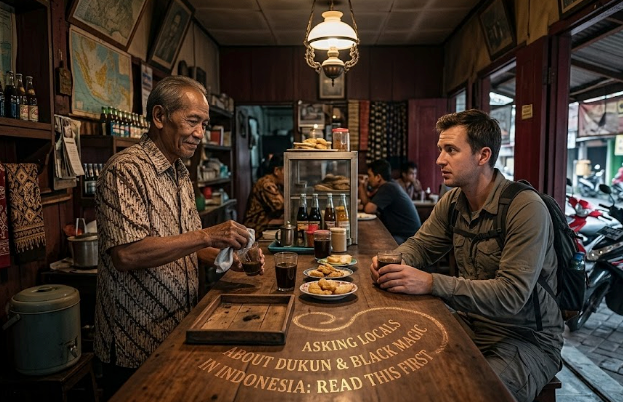
Picture this.
You’re at a warung in Yogyakarta. The coffee is good, the conversation is easy, and the owner has been genuinely warm. Curiosity gets the better of you.
“So — is it true people here practice black magic? Like, can you actually hire someone to curse a person?”
The smile doesn’t disappear. It just shifts. Gets a little more careful. The conversation wraps up faster than it should have. You leave with an odd feeling, like you stepped on something without seeing it.
Here’s what happened. You walked into one of the most loaded conversational territories in Indonesian culture — and the problem wasn’t the topic. It was how you entered it, and who you asked.
What “Dukun” Actually Means
The word gets flattened in travel writing into something like “witch doctor” — exotic, safely distant, a little theatrical.
In reality, dukun is a broad term that covers a huge range of traditional practitioners. A dukun bayi is a traditional midwife. A dukun patah treats fractures and injuries through massage and herbal medicine. A dukun penyembuh is a spiritual healer who deals with illness that conventional medicine hasn’t resolved.
And then there’s dukun santet. Santet is the deliberate use of supernatural means to harm someone specifically — causing illness, destroying a marriage, ruining a business, or worse.
When tourists ask about dukun, they almost always mean santet. And that’s the version of the topic that carries weight most outsiders genuinely don’t understand.
This Isn’t Folklore. People Actually Believe It.
Here’s what most travel content gets wrong.
Belief in santet isn’t something educated, urban Indonesians have moved past. It exists across every education level, every social class, every religious background. A corporate lawyer in Jakarta and a rice farmer in East Java can hold the same genuine conviction that santet is real — that it works, that it happens, that people they personally know have been affected by it.
This matters. Because when you ask about black magic as if it’s a colorful cultural curiosity — like asking about a regional snack or a local festival — you’re asking about something the person across from you may have direct, painful experience with.
In the late 1990s, particularly across East Java, hundreds of people accused of being dukun santet were killed in mob violence. Not in the distant past. Not in isolated incidents. Hundreds of people. Some communities that lived through those years still carry that weight. There are families who lost someone to an accusation.
Casual curiosity, dropped into that context, lands differently than you expect.
Why the Room Goes Quiet
Not every uncomfortable reaction comes from the same place, so it helps to understand what’s actually happening.
Being associated with santet carries real social cost. In Indonesian social logic, if you ask someone where to find a dukun santet, you’re implying they move in those circles. That’s not a neutral question. Even someone with indirect, secondhand knowledge has reason to stay out of it — connecting a stranger to something like this reflects back on them.
Many Indonesians hold two positions at once. Privately, they may believe santet is real, or at least possible. Publicly, they maintain that it’s not something decent people involve themselves with. Asking them to discuss it openly in front of a stranger collapses a boundary they keep deliberately — and for good reason.
It’s not just taboo. It’s feared. There’s a real difference between something being socially sensitive and something that genuinely frightens people. For many Indonesians, talking about santet openly — naming it, describing how it works, speculating about who practices it — feels like inviting something in. The way some people feel about saying certain things out loud, even in places they feel safe.
What Actually Happens When You Ask the Wrong Person
Most of the time, nothing dramatic. The conversation just closes. You get a polite deflection, a subject change, a vague non-answer. The interaction leaves a residue on both sides that neither person quite names.
In some areas — parts of Java, Madura, certain parts of Kalimantan — the question can generate something closer to wariness. Not hostility. Just a quiet recalibration of who you are and what you might actually be there for.
The worst outcome isn’t anger. It’s becoming the tourist that community talks about afterward. The one who didn’t understand where they were.
There’s a Right Way to Be Curious About This
The curiosity itself is legitimate. Indonesia has one of the richest mystical landscapes in the world — Kejawen philosophy, Balinese Hindu cosmology, Bugis maritime spiritual tradition, Dayak ancestor veneration. These aren’t museum pieces. They’re living belief systems, and they’re worth understanding seriously.
The difference is in approach.
Academic framing opens doors that direct questions close. There’s a real gap between “where can I find someone who does black magic?” and “I’ve been reading about Javanese spiritual traditions — can you tell me more about how Kejawen beliefs work?” One sounds like you want a service. The other signals genuine intellectual curiosity. People respond to these two things very differently.
The right people to have this conversation with are knowledgeable local guides who specialize in cultural history — people whose professional role includes explaining these traditions to outsiders, who’ve thought carefully about how to present them accurately and respectfully. Not the warung owner. Not the person you met an hour ago. Not the becak driver who offered to take you somewhere interesting.
And if you’re still getting your bearings — before you ask anyone anything — learning basic cultural etiquette first goes a long way. How you enter a conversation in Indonesia, how you signal respect before you signal curiosity, matters more than the question itself.
Things That Will Genuinely Make People Uncomfortable
Some of these aren’t obvious, so it’s worth being direct.
Asking someone if they know a dukun — even framed as just curious — implies you want access to one. If you don’t, don’t phrase it that way.
Reacting to santet stories as entertainment. “Oh wow, that’s wild” is not the right response when someone shares that a family member was believed to be cursed and died not long after. Read the weight of what you’re being told.
Asking for proof or demonstrations. The assumption that a spiritual practice needs to perform for a skeptical foreign audience is its own kind of disrespect. You don’t have to believe. You do have to not make your disbelief the center of the exchange.
Speculating out loud about whether specific local people might be involved in black magic. This is the version that can cause real harm — not to you, but to the person being talked about.
What You Can Actually Do
There are legitimate, respectful ways to get close to Indonesian mystical traditions as a visitor.
Some cultural tour operators in Bali and Java arrange visits to traditional healers — dukun penyembuh and balian — who work in wellness and spiritual counseling, not harm. These experiences are genuine, often quietly extraordinary, and a completely different category from what most tourists imagine when they hear the word dukun.
Reading before you visit is more useful than most people expect. Clifford Geertz’s The Religion of Java remains one of the most thorough accounts of Javanese spiritual life written in English. You’ll come out with context that makes any conversation more substantive — and changes the quality of the questions you ask.
And sometimes, the best approach is just being patient and quiet. Attending the right events, spending time in the right places, letting people see that you’re genuinely interested rather than hunting for something exotic. The conversations that happen naturally, without an agenda pushing them, tend to be more honest and more illuminating than anything you could have asked for directly.
FAQ
Q: Do Indonesians actually believe black magic is real? A: Many do, across all levels of education and religious background. It’s not a rural or uneducated phenomenon. Belief in santet coexists with Islam, Christianity, and Hinduism in ways that look contradictory from the outside but make complete sense within each tradition’s local form. Treating it as superstition to be debated is a fast way to end any real conversation.
Q: Is practicing santet illegal in Indonesia? A: There’s no law that specifically criminalizes traditional spiritual practice. Causing harm to another person — through any means — falls under general criminal law, but enforcement in this area is complicated. Commercial fraud in the name of spiritual services is prosecutable. The practice itself exists in a largely informal legal space.
Q: Can tourists visit a dukun in Indonesia? A: Yes, in the right context. Visits to traditional healers focused on wellness and spiritual guidance — especially balian in Bali — are a recognized part of cultural tourism and can be genuinely meaningful experiences when approached respectfully. What’s different is specifically seeking out practitioners of harmful magic, which puts you in ethically murky territory and is unlikely to be something a reputable guide will help arrange.
Next read: → Why Indonesians Use Agarwood in Traditional Ceremonies — It’s Not About the Price Tag