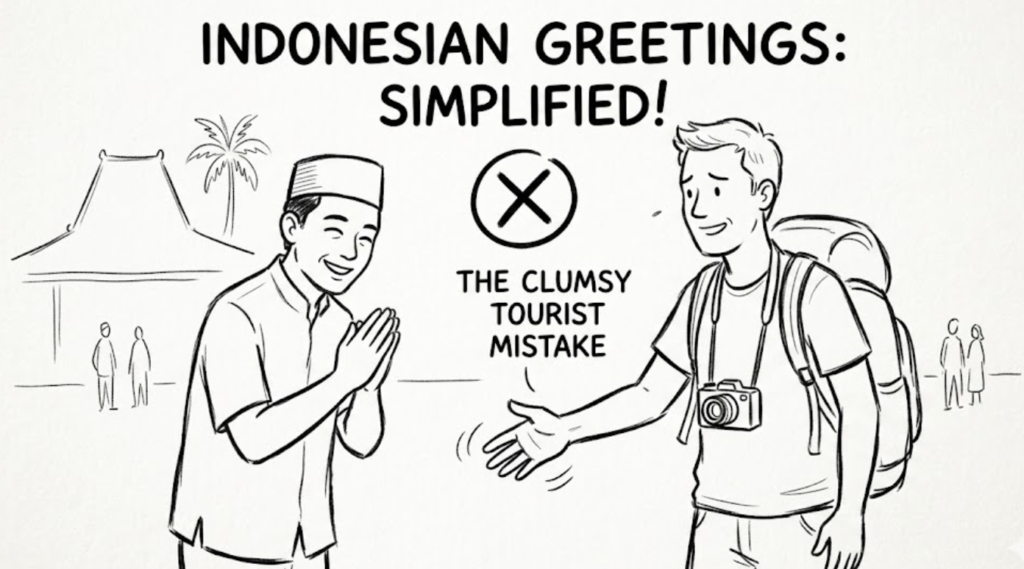
The handshake feels safe. You extend your hand, the Indonesian person takes it, and everyone moves on.
Except the handshake in Indonesia is not what you think it is. The pressure, the timing, what you do with your other hand, whether you bow slightly — all of it is being read in ways most foreign visitors never realize.
Indonesia is not one greeting culture. It is hundreds. The way a Javanese person greets an elder is different from how a Balinese greets a priest, which is different again from how a Dayak community member greets a stranger entering their longhouse.
What follows is the guide that prevents you from accidentally being rude before you’ve even sat down.
The Indonesian Handshake: What You’re Getting Wrong
The standard Indonesian handshake is softer than a Western one. A firm grip reads as aggressive, not confident. Aim for gentle contact.
After shaking, many Indonesians bring their right hand briefly back to their chest. It means: I receive this greeting into my heart. If your counterpart does this, mirror it. Nobody will find it strange. Everyone will appreciate it.
The two-handed handshake — extending your right hand while supporting it at the wrist with your left — signals respect for someone older or more senior than you. It costs nothing and communicates everything.
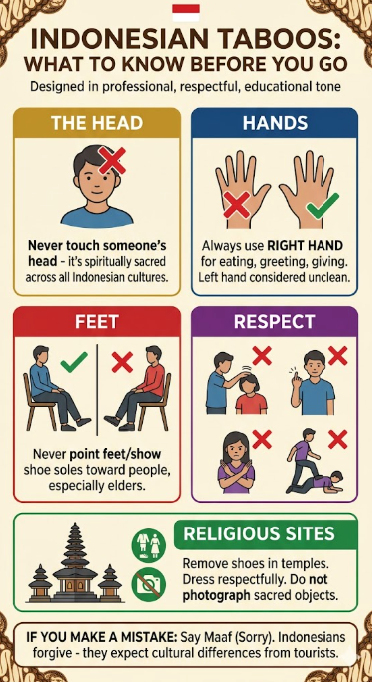
The left hand rule matters everywhere in Indonesia. The left hand is considered unclean across virtually all ethnic and religious groups. Never offer it for a handshake. Never hand something to someone with it alone. If you must, acknowledge it: “Maaf, kiri” — sorry, left hand.
Salim: The Javanese Greeting You’ve Probably Never Heard Of
In Java and Sunda, the handshake is not even the most important greeting. The salim is.
The salim is the gesture of bringing an elder’s right hand to your forehead or lips as a sign of deep respect. Younger people do it to older people. Students do it to teachers. Children do it to parents and grandparents every single day.
If you are introduced to a Javanese elder and they extend their hand lower than normal — palm relaxed, facing down — they may be offering the opportunity for a salim. You are not expected to know the exact form. Simply take their hand gently with both of yours and bow your head slightly. That gesture of deference is what matters, not the precision.
In Bali: “Om Swastiastu”
The traditional Balinese Hindu greeting is “Om Swastiastu” — roughly, may you be blessed by God. The response is the same phrase back.
It comes with the anjali mudra: hands pressed together at chest height, slight bow of the head. You’ll recognize it from Thai wai or Indian namaste. The form is the same. The context is its own.
Using “Om Swastiastu” when entering a temple or greeting a Balinese family earns you something that most tourist interactions don’t: a moment of genuine surprise and warmth. You don’t need to be Hindu. You need to mean it.
In Muslim Communities: The Islamic Greeting
Indonesia is the world’s largest Muslim-majority country. In most of Java, Sumatra, Kalimantan, and Sulawesi, the standard greeting is “Assalamu’alaikum” — peace be upon you — with the response “Wa’alaikumsalam.”
As a non-Muslim, you are not expected to initiate this greeting. But if someone offers it to you, responding with Wa’alaikumsalam is gracious rather than presumptuous.
In most tourist contexts, Indonesians will meet you halfway: “Halo” or “Selamat pagi” — good morning. The universal Indonesian time-based greetings work everywhere, with everyone, regardless of religion or island.
- Selamat pagi — before noon
- Selamat siang — noon to 3pm
- Selamat sore — 3pm to sunset
- Selamat malam — after dark
Learn these four. Use them. They will open more doors than any amount of English.
What Changes by Region
In Aceh: Physical contact between unrelated men and women is avoided. If a man places his hand on his chest rather than extending it, mirror that gesture. It is a respectful non-contact greeting, not a rejection.
In Dayak communities (Kalimantan): When a community leader formally welcomes you into a longhouse, receive that welcome fully — eye contact, a nod, attentive presence even if you don’t understand the language. Walking past it to look at the interior is the kind of rudeness that sticks.
In Papua: Some communities greet by touching noses. If offered by an elder, lean in rather than pulling back.
The Mistakes That Actually Matter
Patting a child’s head. The head is considered the most spiritually elevated part of the body across Indonesian cultures. Affectionate head-patting — completely normal in the West — is offensive here. Compliment the child verbally instead.
Beckoning with one finger. A single raised index finger is how Indonesians call animals. To beckon a person, extend your hand palm-down and curl all fingers toward you.
Crossing your arms. During a greeting or conversation, crossed arms signal closed hostility. Keep your posture open.
Pointing with one finger. Use your thumb with fingers folded, or gesture with your whole hand.
FAQ
Q: Do Indonesians hug as a greeting? A: Between close friends of the same gender, yes. Between men and women who are not family or close friends, physical contact beyond a handshake is unusual and should not be initiated by a foreign visitor.
Q: Is “Halo” acceptable everywhere? A: Completely. It is universally understood and nobody will be offended. Using local greetings simply earns you more warmth than the baseline.
Q: Should I bow when greeting Indonesians? A: A slight bow of the head — not a full Japanese-style bow — is always appropriate and appreciated, especially with elders. The gesture of deference matters more than the depth of it.
Next read: → Is It Safe to Ask Locals About Black Magic and Dukun in Indonesia?