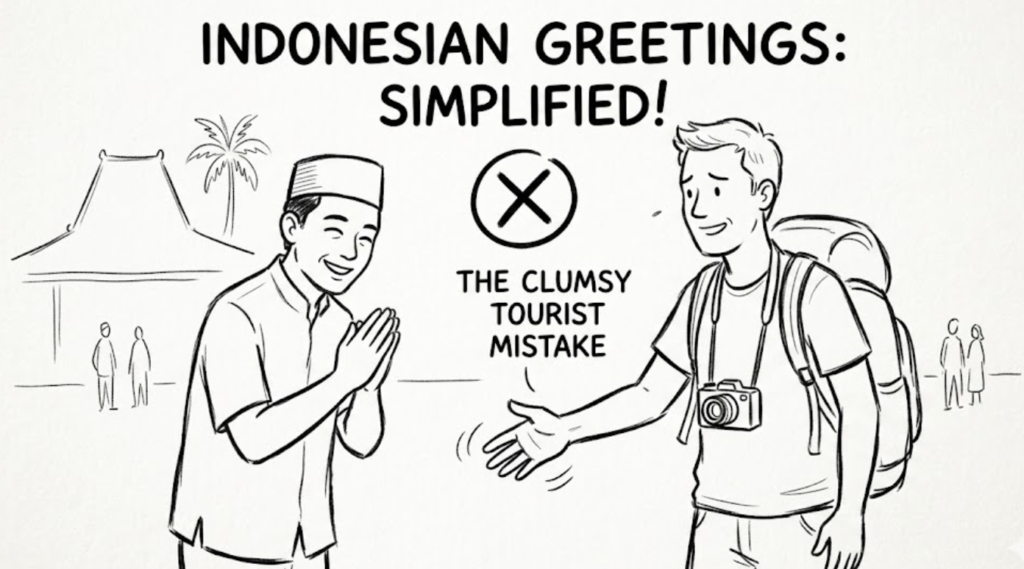
You are invited to a family dinner in Indonesia. The family has welcomed you generously. The food is beautiful. You are relaxed and feeling good about the interaction.
Then you do something small. You pat the child on the head as a gesture of affection. The room changes. Not dramatically — Indonesians are too polite for dramatic reactions — but you feel a subtle shift. The warmth becomes slightly more formal.
What you did was taboo.
The family will forgive you because they understand you are a foreigner and don’t know better. But you have communicated something that was not your intention. You have, without meaning to, shown disrespect.
This guide exists to prevent that moment from happening in the first place. Indonesian taboos are not arbitrary. They encode centuries of understanding about respect, cleanliness, spiritual danger, and proper relationship. Understanding them means understanding Indonesia itself.
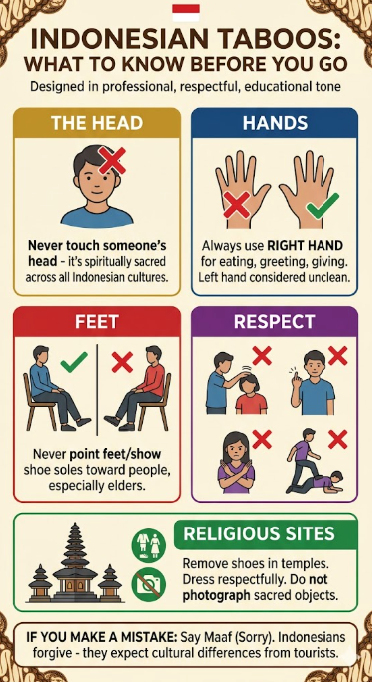
THE HEAD: THE MOST SACRED PART OF THE BODY
Across virtually every Indonesian ethnic group — Javanese, Sundanese, Balinese, Dayak, Minangkabau — the head is considered the most spiritually elevated part of the body. This understanding shows up in architecture, ritual, hierarchy, and daily interaction.
This is the origin of multiple taboos around touching someone’s head.
TABOO: TOUCHING OR PATTING SOMEONE’S HEAD
What it means: The head is sacred space. Touching it casually — even affectionately — is spiritually inappropriate and violates spiritual boundaries.
In Western cultures, patting a child’s head is a universal gesture of affection and approval. In Indonesian culture, it reads completely differently. It reads as a violation of spiritual space, even when meant kindly. A child receiving a head pat from a foreign tourist is experiencing a boundary violation, even if nobody says so explicitly.
Who this affects most:
- Children (patting them on the head is very common in Western contexts and very inappropriate in Indonesian contexts)
- Elders (even more serious)
- Religious leaders (most serious)
What to do instead:
- Express affection verbally
- Place your hand on their shoulder or upper back
- Smile, nod, make eye contact
- If you must touch, touch the arm or shoulder, never the head
Exception: If a child is injured and you need to examine a wound, that is obviously different and understood as practical necessity.
THE LEFT HAND: UNCLEAN AND DISRESPECTFUL
The left hand is considered unclean across virtually all of Indonesia — Islamic, Hindu, Buddhist, and traditional belief systems all agree on this. The reason is practical and deeply embedded in culture.
Historically, in cultures without modern plumbing, the left hand was reserved for personal hygiene. Over centuries, this practical distinction became deeply embedded in culture and spirituality. The right hand became the hand of greeting, eating, giving, and respect. The left hand is never used for these purposes.
TABOO: OFFERING YOUR LEFT HAND OR USING IT FOR EATING/GIVING
What it means: Using your left hand to shake hands, hand something to someone, or eat in front of others communicates disrespect or uncleanness.
Situation 1: Left-handed people If you are naturally left-handed, Indonesians understand this. But make the effort to eat with your right hand if possible, especially in formal or family settings. If you must use your left hand, acknowledge it: “Maaf, kiri” (sorry, left hand). This acknowledgment shows you understand the cultural norm and are not being intentionally disrespectful.
Situation 2: Handing something to someone Always hand objects with your right hand. This includes business cards, gifts, money, food — anything. If both hands are full and you must hand something with your left, use both hands (right hand primary, left supporting) and say “maaf, kiri.”
Situation 3: Eating In formal settings, eat with your right hand. In casual family settings with people who know you, this is less strict, but using your right hand is always the safer choice.
Situation 4: Beckoning someone Never beckon with a single raised index finger. That gesture is reserved for calling animals. To beckon a person, extend your hand palm-down and curl your fingers toward you. This distinction is taken seriously across all of Indonesia.
FEET: THE LOWEST AND LEAST RESPECTFUL BODY PART
If the head is the most spiritually elevated part of the body, the feet are the least elevated. This creates multiple taboos around foot positioning and pointing.
TABOO: POINTING WITH YOUR FEET OR SHOWING THE SOLES OF YOUR FEET
What it means: The foot is spiritually polluted relative to the head and hands. Directing attention toward something with your foot, or displaying the sole of your shoe or foot toward someone, is disrespectful and sometimes spiritually offensive.
Situation 1: Sitting position When sitting, arrange your legs so that the soles of your feet do not point toward another person, especially elders. Tuck your feet under you, angle them to the side, or cross your legs at the thigh — any position that keeps the sole of your foot from being visible to others.
This matters most in:
- Temple visits
- Formal family gatherings
- Religious spaces
- Interactions with elders or people of high status
Situation 2: Pointing at things Never point at something with your foot or toes. Use your right hand with fingers extended, or gesture with your whole hand. This applies to casual pointing — it is taken more seriously than most tourists realize.
Situation 3: Removing shoes In homes and temples, you will remove your shoes. When doing so, keep them neatly together, never with the soles pointing toward people. This is a small detail, but people notice.
FOOD AND EATING: COMPLEX CULTURAL RULES
TABOO: LEAVING RICE UNEATEN ON YOUR PLATE
In Indonesian culture — shaped by historical periods of food scarcity — leaving rice uneaten on your plate is spiritually wasteful and somewhat offensive. Rice is never considered a disposable food item. It represents sustenance and survival.
What to do:
- Take only what you will eat
- If you are full, it is acceptable to leave other foods on your plate
- But rice should be eaten or deliberately refused from the start
Exception: If you have a genuine allergy or cannot eat rice for religious reasons, explain this clearly. Indonesians are understanding about allergies.
TABOO: EATING WITH SOMEONE OF OPPOSITE GENDER (In Conservative Contexts)
In more conservative areas, particularly in Aceh and some rural Islamic communities, eating together as an unrelated man and woman can be culturally sensitive. This is less of an issue in tourist areas and major cities, but it exists.
What to do:
- In very conservative areas, be aware of this
- In tourist areas and cities, this is not typically an issue
- If you sense discomfort, follow the lead of the person you are with
TABOO: REFUSING OFFERED FOOD (Minor but noticeable)
If someone offers you food, refusing it entirely can feel like a personal rejection to them. Even if you are not hungry, accepting and eating at least a small amount is gracious.
Exception: Allergies, religious restrictions, dietary limitations — these are all understood and respected.
SPIRITUAL AND RELIGIOUS TABOOS
TABOO: DISRESPECTING RELIGIOUS SPACES AND OBJECTS
In temples (Hindu Bali):
- Remove shoes before entering
- Do not point at religious statues or images
- Do not pose for photos making fun of religious imagery
- Dress respectfully (covered knees and shoulders minimum)
- Do not eat in temple grounds unless invited
- Do not touch offerings or religious objects
In mosques (Islamic areas):
- Remove shoes
- Do not enter prayer areas if not Muslim (non-Muslims can visit certain sections but stay outside prayer halls)
- Dress respectfully (covered knees and shoulders)
- Do not handle Qur’ans or Islamic texts unless invited
- Be silent during prayer times
- Women: avoid entering during women’s prayer times unless invited
With religious leaders:
- Treat them with particular respect
- Never touch their head
- Stand or sit slightly lower than they are, if possible
- Use formal address
TABOO: CERTAIN DAYS AND TIMES
In Bali and Hindu areas, certain days are considered spiritually significant or unlucky for certain activities. In Islamic areas, certain times (like prayer times) are spiritually important.
What to do:
- Ask locally about auspicious and inauspicious days
- Be respectful of prayer times in Islamic areas
- Don’t schedule activities that might conflict with major religious observances
MISCELLANEOUS BUT IMPORTANT TABOOS
POINTING WITH ONE FINGER
Never point with a single extended index finger. Use your whole hand or fold other fingers and point with your thumb.
CROSSING YOUR ARMS
During greeting or conversation, avoid crossing your arms. It signals closed hostility or defensiveness.
STEPPING OVER SOMEONE
If someone is sitting or lying down, never step over them. Walk around. Stepping over someone is disrespectful and violates personal space in a serious way.
WHISTLING AT NIGHT
In some traditional Indonesian beliefs, whistling at night can attract spiritual entities. This is less common in modern urban areas but worth knowing in traditional or rural settings.
GIVING GIFTS IN CERTAIN NUMBERS
The number four is associated with death in some Asian cultures. Avoid giving gifts in sets of four. Odd numbers (3, 5, 7) or even numbers other than four are fine.
WHAT TO DO IF YOU MAKE A MISTAKE
You will probably violate one of these at some point. Indonesians expect this from foreigners and are generally forgiving.
If you realize you made a mistake:
- Apologize sincerely: “Maaf” (sorry)
- Briefly explain: “Saya tidak tahu” (I didn’t know)
- Move on — do not obsess over it
What you should NOT do:
- Make excuses about how “in my culture it’s fine”
- Repeat the mistake
- Act defensive
Indonesians are remarkably gracious about cultural mistakes. Your sincere effort to understand and respect their culture will be appreciated far more than your perfect execution of cultural norms.
FAQ
Q: Do I need to follow these taboos as a tourist if I don’t believe in them?
A: Yes. You are a guest in someone else’s culture. Following taboos is a form of respect, regardless of your personal beliefs.
Q: What if I am left-handed? Do I really have to use my right hand?
A: Make the effort in formal situations. In casual settings with people who know you, this is less strict. But acknowledge the cultural norm.
Q: Are these taboos the same everywhere in Indonesia?
A: The major ones (head, left hand, feet, rice) are fairly universal. Regional variations exist. In major cities, enforcement is looser. In traditional or religious areas, taboos are taken more seriously.
Q: What is the worst taboo to violate?
A: Disrespecting religious spaces and objects, or being deliberately disrespectful to elders. Accidental violations of eating or gesture etiquette are easily forgiven.
Q: Can I ask Indonesians about these taboos directly?
A: Absolutely. Most Indonesians enjoy explaining their culture and will be pleased by your interest and effort to understand.