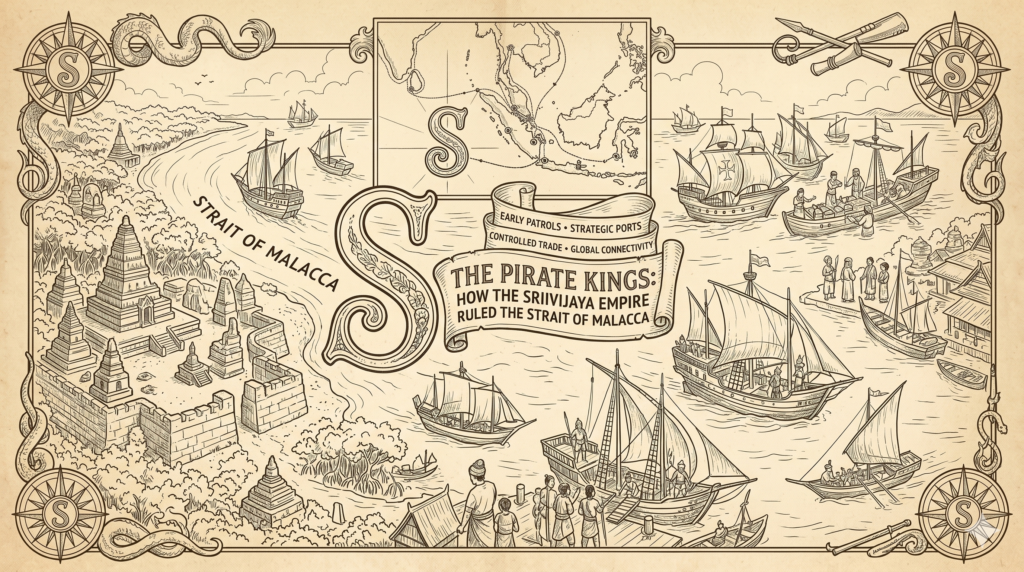
The Pirate Kings: How the Srivijaya Empire Ruled the Strait of Malacca
There is a passage of water between Sumatra and the Malay Peninsula that is, by most measures, the most important stretch of ocean in the world.
At its narrowest point, the Strait of Malacca is 65 kilometers wide. Through it passes roughly 40 percent of global trade today — oil tankers, container ships, cargo vessels carrying everything from electronics to grain. Singapore sits at its eastern mouth, one of the wealthiest cities on earth, built almost entirely on the logic of controlling what moves through that water.
Singapore has been doing this for two hundred years.
Srivijaya did it for six hundred.
The Chokepoint That Built an Empire
To understand how Srivijaya worked, you need to understand what a chokepoint means in maritime history.
If you want to move goods between the Indian Ocean and the South China Sea — between India, Persia, Arabia on one side, and China, Japan, Korea on the other — you have two options. You can sail around the entire Indonesian archipelago, adding weeks to your journey through some of the most difficult open ocean in the world. Or you can go through the Strait of Malacca.
Every merchant in Asia chose the strait. Every time.
And Srivijaya sat at the entrance.
This was not an accident. The kingdom’s founders understood with complete clarity that controlling this passage meant controlling the most valuable trade corridor on earth. The question was never whether to control it. The question was how.
The Answer Was Not Quite What You’d Expect
The conventional image of an empire that controls a strategic waterway involves a large standing navy, fortified ports, and the kind of organized military force that can credibly threaten any ship that doesn’t comply.
Srivijaya had some of that. But its real mechanism of control was stranger and more sophisticated.
It was piracy — or rather, the management of piracy.
The waters around Sumatra and the Malay Peninsula were full of seafaring communities who had been raiding and trading in roughly equal measure for centuries before Srivijaya existed. The Orang Laut — the “Sea People” — were nomadic maritime communities who lived on their boats, knew every current and reef in the strait with the intimacy of people who had never lived anywhere else, and who could descend on a merchant vessel with a speed and local knowledge that no foreign naval force could match.
Srivijaya didn’t try to eliminate them.
It hired them.
The Orang Laut: Srivijaya’s Secret Weapon
The relationship between Srivijaya and the Orang Laut is one of the most fascinating and least-discussed arrangements in medieval history.
The Orang Laut became the operational arm of Srivijayan naval power — scouts, enforcers, intelligence gatherers, and when necessary, the force that reminded any merchant ship exactly what happened to those who tried to bypass Srivijayan toll stations.
In exchange, Srivijaya gave them recognition, a share of the proceeds, and something arguably more valuable: protection from being treated purely as criminals. Within the Srivijayan system, the Orang Laut were not pirates. They were an authorized naval force. The distinction between piracy and taxation, in the Strait of Malacca during Srivijaya’s peak, was entirely a matter of whether you had Srivijayan authorization.
Ships that paid the toll and traded through Srivijayan ports received safe passage, provisioning, and the protection of that same Orang Laut network against anyone else who might threaten them.
Ships that tried to avoid the toll — that attempted to slip through the strait without stopping, without paying, without acknowledging Srivijayan authority — discovered very quickly that the waters were significantly less safe than they had hoped.
This was not random. It was a system.
What the Toll Actually Bought You
Here is what made Srivijaya’s arrangement genuinely brilliant rather than merely coercive.
The empire didn’t just take money from passing ships. It offered something real in return.
Srivijayan ports were exceptional. The capital — almost certainly in the area of modern Palembang — was a cosmopolitan entrepôt where a merchant could find warehousing, currency exchange, translators who spoke a dozen languages, repair facilities for damaged vessels, and a market where goods from across the known world changed hands. Stopping at Srivijaya wasn’t just paying a tax. It was accessing the best-connected marketplace in Asia.
The intelligence network was unmatched. Because Orang Laut communities ranged across thousands of kilometers of coastline and open water, Srivijaya had real-time information about ship movements, weather conditions, and the activities of rival powers that no land-based empire could replicate. This information was commercially valuable — merchants who traded with Srivijaya’s blessing got access to market intelligence that made their voyages more profitable.
The political connections opened doors. Srivijaya maintained formal diplomatic relationships with the Tang and Song dynasties of China, with kingdoms across mainland Southeast Asia, and with trading communities stretching to the Persian Gulf. A merchant ship that arrived in a Chinese port under Srivijayan endorsement was a ship with a recognized identity — not just a vessel from somewhere in the south, but a participant in a recognized political and commercial network.
The toll bought you into a system. Most merchants decided the system was worth it.
The Curse Inscriptions: Governing Through Fear
For the merchants who weren’t convinced by the commercial logic, Srivijaya had another tool.
The empire’s founding inscriptions — some of the oldest texts in the Malay language, dating to the late 7th century — contain passages that read less like royal proclamations and more like threats. The sumpah formula: elaborate curses directed at anyone who betrayed the Srivijayan king’s authority, refused to submit to his power, or attempted to undermine the political order.
The curses are specific. Visceral. They involve crocodiles, demons, supernatural disease, and the destruction of the traitor’s family line across generations.
These were not empty rhetoric. They were governance technology.
In a maritime empire without the capacity to station permanent military forces at every point in a vast and scattered network, the fear of supernatural punishment was a genuine enforcement mechanism. The communities that submitted to Srivijayan authority did so partly because the commercial benefits were real — and partly because the consequences of defection were understood to extend beyond the physical and into the spiritual world.
The king of Srivijaya was not just a powerful ruler. He was a figure whose authority was understood to be cosmically ordained, whose curses carried weight in the invisible world as well as the visible one.
When the System Broke Down
For six centuries, it worked.
Then, in 1025 CE, something happened that no Srivijayan king had seriously considered possible.
The Chola Empire of South India — one of the great naval powers of the medieval world — launched an extraordinary expedition across the Bay of Bengal and directly attacked Srivijayan ports. Rajendra I, the Chola king, sent a fleet thousands of kilometers from home and systematically raided the cities that formed the backbone of Srivijaya’s commercial network.
The raids did not destroy Srivijaya. The empire continued for another two centuries. But they broke something that was harder to rebuild than any city: the reputation for invincibility.
Once it was demonstrated that Srivijayan ports could be attacked and plundered, the entire psychological architecture of the toll system began to crack. The Orang Laut’s value as enforcers depended on the assumption that Srivijayan authority was absolute. Once that assumption was challenged, other powers began to reconsider their arrangements.
The unraveling was slow. But it was also, in retrospect, inevitable.
A system built on the control of movement cannot survive once other people learn how to move without you.
What Remains
The Strait of Malacca is still there. The trade still flows through it.
Singapore, Malaysia, and Indonesia now share jurisdiction over the waterway that Srivijaya once controlled alone. The modern navies of three nations patrol waters that the Orang Laut once watched for a single empire. Multinational anti-piracy task forces operate in the same passages where Srivijaya’s authorized pirates once operated with royal blessing.
The logic of the chokepoint has not changed in a thousand years. Whoever controls this water controls the flow of the world’s commerce.
Srivijaya understood this before anyone else. For six centuries, it acted on that understanding with a sophistication that most of the world is still catching up to.
FAQ
Q: Was Srivijaya actually a pirate state? A: That depends entirely on your point of view — and this was true in the medieval period as much as it is now. From the perspective of merchants who paid the toll and received protection, Srivijaya was a legitimate maritime power providing a genuine service. From the perspective of merchants who tried to bypass the system and were attacked, it was extortion backed by naval force. The historical reality is that the distinction between piracy and maritime taxation was, in this case, almost entirely a matter of political recognition. Srivijaya had it. Its competitors didn’t.
Q: Who were the Orang Laut and what happened to them? A: The Orang Laut were maritime nomadic communities who lived across the waters of the Strait of Malacca and surrounding seas. After Srivijaya’s decline, different groups were absorbed into various successor states — some became the naval forces of the Malacca Sultanate, others maintained relative independence, and some gradually transitioned to settled coastal life. Descendants of Orang Laut communities still exist in Malaysia, Singapore, and Indonesia today, though the fully nomadic maritime lifestyle has largely disappeared.
Q: How did Srivijaya’s navy compare to other medieval naval powers? A: In its home waters, it was almost certainly without peer during its peak centuries. Srivijaya’s advantage was not in having the largest fleet or the most sophisticated warships — it was in the combination of deep local knowledge through the Orang Laut, an intelligence network that covered thousands of kilometers of coastline, and political authority that made its naval actions legitimate rather than criminal. The Chola raids of 1025 CE demonstrated that a determined external power with superior long-range naval capacity could challenge Srivijaya — but even the Chola could not occupy or administer the strait. They could raid it. They could not control it the way Srivijaya did.
Q: Could a similar maritime empire exist today? A: Not in the same form — modern international maritime law, the United Nations Convention on the Law of the Sea, and the naval capacity of multiple nation-states make it impossible for a single entity to control a major international waterway the way Srivijaya did. But the underlying logic — that whoever controls the Strait of Malacca controls an enormous proportion of global trade — is as true today as it was in the 9th century. This is why the strait remains one of the most geopolitically sensitive bodies of water on earth.
Next read: → The Lost Kingdom of Srivijaya: Where Did Indonesia’s Greatest Empire Disappear?