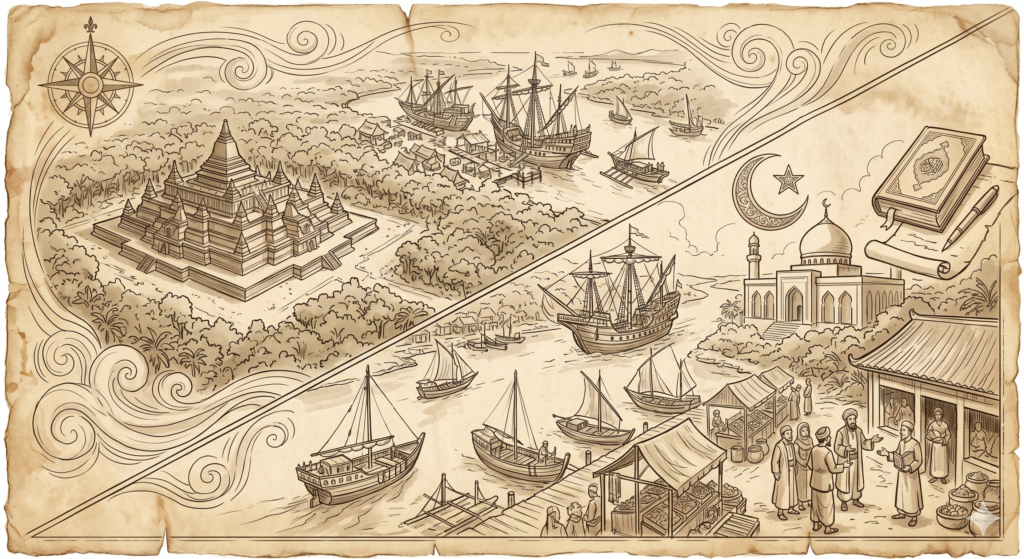
The call to prayer echoes across the Musi River five times a day in Palembang. Women in hijabs fill the morning markets. The Grand Mosque dominates the skyline.
Now look down.
Somewhere beneath the asphalt and the centuries of a living city lie the remains of the most powerful Buddhist empire Southeast Asia has ever seen. The monks who studied Sanskrit here. The gold the king threw into this very river every morning as an offering. The naval fleets that made every merchant ship between China and India pay to pass through.
Palembang is both of these things at once. And the story of how the Srivijaya empire’s Islamic history in Sumatra unfolded — how a Buddhist civilization became the cradle of Islam in the archipelago, without conquest, without forced conversion, without a single decisive battle — is one of the quietest and most remarkable transitions in world history.
The Buddhist Empire That Owned the Sea
At its peak, Srivijaya was not a kingdom in the way most people imagine kingdoms. It had no great stone temples, no monumental palace complex, no single walled city you could point to on a map.
It had the water.
The Strait of Malacca — the narrow passage between Sumatra and the Malay Peninsula — was Srivijaya’s chokepoint. Every merchant ship carrying silk from China, spices from the Maluku Islands, and textiles from India had to pass through it. Srivijaya taxed them, protected them, and sent them on their way. This was the engine of an empire that lasted six centuries.
The Chinese monk I Jing stopped here in 671 CE and counted more than a thousand Buddhist monks in residence. He wrote home urging other pilgrims to study in Srivijaya before continuing to India — the scholarship here, he said, was that good.
This was the civilization that eventually became Islamic Palembang. If you want to understand the full scale of what it was before that transition, the story starts here: The Lost Kingdom of Srivijaya: Where Did Indonesia’s Greatest Empire Disappear?
Islam Arrived on a Merchant Ship, Not a Warship
This is the part that surprises most people.
There were no armies. No caliphate generals marching across Sumatra. No moment where a Buddhist king surrendered to a Muslim conqueror and ordered his people to convert.
Islam arrived in Sumatra the way it arrived across most of maritime Southeast Asia: slowly, quietly, carried in the cargo holds of Arab, Persian, and Gujarati merchant ships that had been sailing the ancient Indonesian trade routes for centuries.
Muslim traders were present in Srivijayan ports from at least the 9th century. Early Islamic gravestones found in northern Sumatra date to the 11th and 12th centuries — centuries before any political transition happened. These traders were not missionaries. But they were devout, they were visibly successful, and they conducted their business according to a recognizable ethical and legal framework that Sumatran port rulers found genuinely useful.
A port that welcomed Muslim traders plugged into the most powerful commercial network on earth. That was reason enough.
The Religion That Didn’t Feel Foreign
Here is what made Islam’s spread in Sumatra different from how religious transitions usually look in history books.
The Islam that arrived was predominantly Sufi in character. Sufi teachers — wandering mystics, spiritual guides, holy men — had a particular gift for finding common ground between the faith they carried and the spiritual landscape they walked into.
In Sumatra, that landscape was Buddhist and animist — full of ancestor spirits, sacred objects, invisible forces that shaped the visible world. Sufi Islam, with its emphasis on inner experience, mystical closeness to God, and the spiritual power of holy men, found more connections than conflicts with what was already there.
The Buddhist concept of the enlightened teacher who stays in the world to guide others had an easy parallel in the Sufi wali — the “friend of God” whose spiritual attainment brings blessing to everyone around him. Nobody had to abandon the idea that sacred knowledge could live in a person. They just learned a new name for it.
The transition didn’t feel like a replacement. It felt like a deepening.
Marriage Did What Armies Couldn’t
The most important mechanism of Islamization in Sumatra was not preaching. It was marriage.
Successful Muslim traders who settled in Sumatran port cities married into local aristocratic families. Their children were Muslim — but also Malay, also Sumatran, also heirs to the traditions of their mothers’ communities.
Over two or three generations, this produced something entirely new: Muslim Malay nobility. People who understood both worlds completely. Who spoke Arabic and Old Malay. Who could navigate Islamic law and Malay adat (customary tradition) simultaneously.
These were not converts who had abandoned their identity. They were people who had absorbed a new religious framework into an existing cultural one — and who then governed accordingly.
This is how the Palembang Sultanate eventually emerged: not as a foreign imposition, but as a local evolution.
The Prince Who Carried Srivijaya Into a New World
One figure crystallizes the entire transition.
Parameswara — a prince of Srivijayan lineage, born into the Buddhist-Hindu Malay aristocratic tradition — fled Palembang in the late 14th century under pressure from the expanding Majapahit Empire of Java. He eventually settled on the Malay Peninsula and founded what would become the Sultanate of Malacca around 1400 CE.
He later converted to Islam, took the name Iskandar Shah, and his successors made Malacca the most important Islamic trading port in Southeast Asia.
Think about what that means. The maritime networks built by Srivijaya’s Buddhist kings — the trade routes, the port relationships, the diplomatic connections across the Indian Ocean — were inherited intact by a Muslim sultanate. The infrastructure of Buddhist maritime power became the infrastructure of Islamic expansion.
Nothing was destroyed. Everything was repurposed.
What Srivijaya Left Inside Islamic Palembang
If you know where to look, the Buddhist empire is still visible in Palembang today.
Not in ruins. In living things.
The Grand Mosque of Palembang — built in 1748 — has a multi-tiered roof in the traditional Malay style that carries unmistakable echoes of Buddhist and Chinese temple architecture. The layered structure, the upward-curving eaves: this is not an Islamic form. It is a form that was already here, absorbed into the mosque without apology or contradiction.
The Indonesian language itself carries Srivijaya’s fingerprints. Hundreds of everyday words in Bahasa Indonesia are Sanskrit — absorbed during the Buddhist era and never replaced. Bahasa (language). Raja (king). Agama (religion). Desa (village). Every Indonesian speaker uses these words every day without knowing they are speaking a language shaped by a Buddhist empire whose ruins lie beneath Palembang’s streets.
And in Palembang’s ceremonial life — in weddings conducted under Islamic law, in the formal language of traditional gatherings, in the specific sequences of ritual that mark important events — there is cultural memory that goes back further than any mosque in the city.
The Buddhist and Islamic cultural mix here is not a historical curiosity. It is the texture of ordinary life.
FAQ
Q: Did Srivijaya convert to Islam all at once? A: No. The transition happened gradually over several centuries, driven by trade, intermarriage, and the organic spread of Sufi Islamic practice. There was no single moment of conversion. By the time the Palembang Sultanate formally emerged as an Islamic political entity in the 16th century, Muslim communities had already been present in the region for hundreds of years.
Q: Why did Islam spread so successfully through Srivijaya’s old trade network? A: Srivijaya had spent six centuries building the most extensive maritime trade network in Southeast Asia. When Muslim traders became dominant in Indian Ocean commerce, they inherited those same routes and port relationships. The network was already there — Islam traveled along it the way any powerful idea travels: through the connections that commerce creates.
Q: Can you still see evidence of Srivijaya’s Buddhist past in Palembang? A: Yes. Buddhist artifacts recovered from the Musi River — gold statuary, Sanskrit inscriptions, Chinese ceramics — are held in the Museum Sultan Mahmud Badaruddin II. The Bukit Seguntang hill on the city’s western edge contains burial mounds associated with Srivijayan royalty. And in the layered architecture of the city’s oldest mosque, a Buddhist visual grammar quietly persists inside an Islamic house of prayer.
Next read: → The Lost Kingdom of Srivijaya: Where Did Indonesia’s Greatest Empire Disappear?