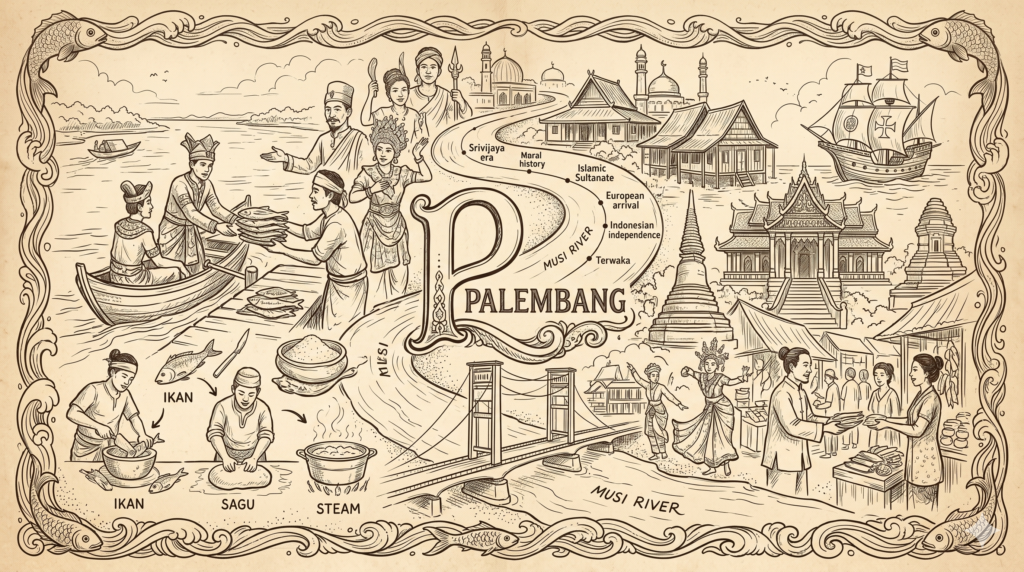
Every city has a dish that is more than food.
In Palembang, that dish is pempek — a fish cake made from ground fish and tapioca, fried or boiled, then drowned in a dark, sour, barely-sweet vinegar sauce called cuko. It is sold on almost every street corner. It is eaten for breakfast, lunch, dinner, and at midnight. Palembang residents who move to Jakarta or Surabaya will tell you, without any irony, that they miss pempek the way other people miss their family.
But pempek is not just comfort food. It is a historical document.
Every ingredient in it, every technique behind it, every element of how it is made and eaten tells you something about who passed through Palembang — and who stayed. The Musi River. The Chinese traders. The Srivijayan empire. The spice routes. All of it is sitting in a bowl of cuko, if you know how to read it.
A River City That Fed the World
Before you understand pempek, you need to understand the Musi River.
Palembang was built on the Musi — a wide, brown, constantly moving river that connects the interior of Sumatra to the sea. For centuries, this river was one of the most important waterways in Asia. Everything moved through it: Chinese ceramics, Indian textiles, Sumatran gold, Maluku spices. The city that sat at its mouth grew rich on what passed through.
And what the river gave Palembang, more than anything else, was fish.
The Musi and its tributaries were extraordinarily abundant. Gabus (snakehead fish), tenggiri (Spanish mackerel), belida (featherback fish) — these were not luxury ingredients. They were the protein of everyday life, caught daily by Palembang’s river communities and carried into the city markets by the boatload.
A civilization with this much fish and this much time eventually figures out what to do with it.
Where Pempek Actually Came From
The origin story of pempek is one of those histories where the truth is more interesting than the legend.
The most commonly told version goes like this: in the 16th century, a Chinese man — elderly, carrying fish and tapioca — wandered through Palembang selling his mixture. People called out to him using the informal Chinese address apek (uncle, for an older man). Over time, apek became pempek, and the dish took his name.
It is a good story. It is probably not entirely wrong.
Chinese traders and settlers had been present in Palembang since at least the Srivijayan era — the empire’s cosmopolitan port attracted merchants from across Asia, and Chinese communities established themselves along the Musi River centuries before the 16th century. The technique of binding ground fish with starch to create a firm, fryable cake is consistent with Chinese culinary traditions that were present in Palembang long before the apek of legend arrived.
But the dish is not Chinese. It is Palembang.
The fish are from the Musi. The tapioca comes from the cassava that grows across Sumatra. The cuko — that dark, punishing sauce that is pempek’s essential companion — is built on palm sugar, bird’s eye chili, and fermented garlic in proportions that are entirely local. No Chinese dish tastes like cuko. No Chinese tradition produces anything quite like it.
What happened in Palembang is what has always happened in great port cities: a technique arrived by boat, met the ingredients of the place it landed, and became something entirely new.
What Pempek Actually Is: A Field Guide
Pempek is not one thing. It is a family of things, and Palembang people are particular about the distinctions.
Pempek Kapal Selam — “Submarine pempek” — is the most famous. A large oval of fish paste encasing a whole raw egg, which cooks inside the dough when it is boiled and then fried. When you cut it open, the egg is there. This is considered the flagship form, the one that defines the category.
Pempek Lenjer is the simplest — a plain cylinder of fish paste, boiled and fried. The purist’s choice. The quality of the fish and the ratio of fish to tapioca is nowhere to hide in a lenjer.
Pempek Adaan is round, slightly spicy, fried directly without boiling. A different texture — crispier, denser — from the same base ingredients.
Pempek Keriting is made by pressing the fish paste through a mold to create a curly, noodle-like form. More surface area means more cuko absorption, which is the entire point.
Pempek Pistel is filled with a mixture of young papaya — a distinctly local variation that shows how Sumatran ingredients found their way into the Chinese-influenced base form.
All of them are eaten with cuko. Always. A Palembang person who tells you they eat pempek without cuko is lying to you.
The Cuko: The Sauce That Carries Everything
If pempek is the body of this dish, cuko is the soul.
Cuko is made from water, palm sugar, fermented garlic, bird’s eye chilies, and sometimes the addition of dried shrimp paste. It is cooked down until it thickens slightly — dark brown, sweet at first, then immediately sour from vinegar, then burning from the chilies in a way that builds slowly rather than hitting all at once.
There are two camps in Palembang: those who want their cuko sweet and mild, and those who want it sharp and brutal. Both camps are convinced the other is wrong. This is a debate that has been running for generations and will not be resolved in this article.
What cuko does is balance the mild, slightly salty fish cake against something acidic and complex. The fish cake is soft and yielding. The cuko is aggressive. They need each other.
The palm sugar in cuko connects this dish to the agricultural traditions of Sumatra’s interior — the same sugar that sweetens Sumatran coffee, the same ingredient that appears in ceremonial food across the region. The chili reflects centuries of spice trade influence. The fermented garlic is the fingerprint of Chinese culinary practice absorbed into local tradition.
Cuko is a sauce that tastes like Palembang’s history.
From the River to the Nation
Pempek stayed in Palembang for a long time. For centuries it was essentially a local thing — known in Sumatra, unknown elsewhere.
Then came the 20th century, and migration.
As Palembang’s population moved — to Jakarta for work, to other cities for education, to wherever opportunity took them — they carried pempek with them. Palembang restaurants opened in Jakarta. Frozen pempek began to be shipped across the country. The dish that had been a Musi River specialty became something people encountered in food courts from Medan to Makassar.
Today, pempek is recognized as one of Indonesia’s national culinary heritage dishes. The Ministry of Education and Culture has listed it as part of Indonesia’s intangible cultural heritage — the same category of recognition that covers batik and wayang kulit.
A fish cake. Alongside the greatest textile tradition in the world and a shadow puppet theater that runs through the night.
Palembang people will tell you this is entirely appropriate.
Where to Eat Pempek in Palembang
The short answer: everywhere. You cannot walk a significant distance in Palembang without encountering pempek.
But there are places worth seeking out.
Pempek Candy on Jalan Merdeka is one of the oldest and most respected names in the city — a restaurant that has been operating long enough that multiple generations of Palembang families have grown up eating there. The lenjer is the test: simple, honest, nothing hidden.
Pasar 16 Ilir — Palembang’s oldest and largest traditional market, sitting directly on the Musi River — has pempek vendors who have been in the same spots for decades. This is where you eat pempek the way it was eaten before it became famous.
The Ampera Bridge area along the riverfront has clusters of pempek restaurants where you can eat looking out at the Musi River — the same river that produced the fish, fed the empire, and gave Palembang everything it has ever had.
Order a plate of kapal selam. Pour the cuko over it. Eat slowly.
You are sitting at the confluence of six hundred years of history.
FAQ
Q: What fish is traditionally used in pempek? A: The traditional fish for authentic Palembang pempek is ikan belida — the giant featherback fish (Chitala lopis) native to the Musi River and Sumatran rivers. Belida has a particular texture and fat content that produces the finest pempek. Because belida is now rare and expensive due to overfishing, most modern pempek is made with tenggiri (Spanish mackerel) or gabus (snakehead fish), both of which produce excellent results. Pempek made with cheap, low-quality fish is immediately detectable in the final taste.
Q: Can I bring pempek home from Palembang? A: Yes — and this is one of the best food souvenirs in Indonesia. Most Palembang pempek shops sell vacuum-packed frozen pempek specifically designed for travel, along with bottled cuko sauce. It survives a domestic flight without problems. For international travel, check your destination country’s customs rules on processed seafood products.
Q: Is pempek gluten-free? A: Traditional pempek is made from fish and tapioca starch, which is naturally gluten-free. However, some modern versions and commercial preparations add wheat flour as a filler, which reduces quality and adds gluten. Always confirm the ingredients if you have dietary restrictions.
Q: Why does pempek in Jakarta taste different from Palembang? A: Several reasons. The fish used in Palembang is fresher and more likely to be the traditional varieties. The cuko recipe varies by restaurant, and Palembang cuko tends to be more precisely calibrated. And there is the honest factor of local pride and competition — Palembang pempek makers know their reputation rests on the product, which tends to produce better results than pempek made far from the source.
Next read: → How the Srivijaya Empire Became Islamic — Without a Single Battle