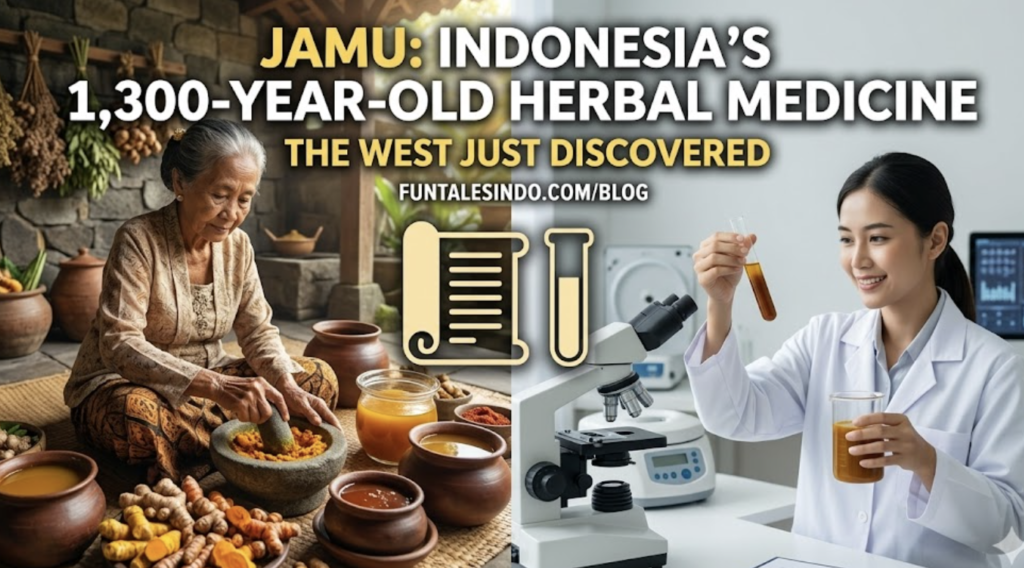
In cities and villages across Java, a woman walks the streets each morning carrying a basket loaded with small bottles of dark liquid — yellowish, brown, deep green, occasionally an unsettling black.
People come out of their homes and offices to meet her, exchange a few coins, drink a small glass on the spot — grimacing slightly — and go back to whatever they were doing.
This is the jamu gendong — the jamu seller who carries her medicine on her back. She is so embedded in Javanese daily life that locals barely notice her anymore.
What she carries is jamu: Indonesia’s ancient system of herbal medicine, developed over at least 1,300 years and encoded in the same cultural tradition that produced Borobudur. The global wellness industry is just beginning to notice it. Indonesians never stopped using it.
What Jamu Is
Jamu is the Javanese term for traditional Indonesian herbal medicine — preparations made from plants, roots, bark, seeds, and minerals, formulated according to knowledge passed down through generations of healers, palace physicians, and family practice.
The word appears in Javanese manuscripts dating to the 8th and 9th centuries CE. The Serat Centhini — a major Javanese literary encyclopedia from the early 19th century — documents jamu formulations extensively, but describes them as established traditional knowledge, not new innovations. This was already old when it was written down.
Jamu is not alternative medicine in the Indonesian context. It is medicine — the primary healthcare system that sustained the population for over a millennium before Western pharmaceuticals arrived with colonialism.
The Core Ingredients
Kunyit (Turmeric) — The foundational ingredient. Used in dozens of formulations, recognized globally now for its anti-inflammatory properties. In jamu tradition, it treats digestive issues, skin conditions, and functions as a general daily tonic. Jamu kunyit asem — turmeric with tamarind and palm sugar — is the most widely consumed daily jamu and what most sellers offer first.
Jahe (Ginger) — For circulation, nausea, respiratory conditions. The Javanese distinguish between several varieties, each with different properties and applications.
Temulawak (Javanese Turmeric) — A cousin of turmeric used particularly for liver health and digestive function. Modern pharmacological research has confirmed demonstrable hepatoprotective properties.
Kencur (Aromatic Ginger) — A small rhizome with a distinctive medicinal flavor, used for respiratory health, muscle pain, and energy.
Sambiloto (Andrographis) — Called the king of bitters. Used for fever, immune support, and infections. Among jamu ingredients, it has the most robust modern pharmacological evidence behind it.
The Spice Islands spices — cinnamon, cloves, nutmeg — appear throughout jamu formulations too. The most valuable trade commodities in medieval Asian history, used here as medicine long before they became luxury exports.
The Jamu Gendong: A Pharmacy That Walks to You
The jamu gendong prepares her formulations at home before dawn, loads them into bottles in a basket carried on her back, and begins her rounds in the early morning hours.
Her customer base is a standing clientele — people who have bought from her for years, whose names she knows, whose health concerns she tracks, whose formulations she adjusts over time. She is not a vendor. She is a community health practitioner.
Her standard formulations:
- Kunyit asem — turmeric and tamarind, the general daily tonic
- Beras kencur — aromatic ginger and rice, for energy and muscle recovery
- Cabe puyang — chili and lempuyang ginger, for rheumatic pain and fatigue
- Pahitan — bitter formulations with sambiloto, for fever and blood purification
- Galian singset — a women’s health formulation for post-childbirth recovery
Her knowledge represents generations of accumulated practical pharmacology. Her daily rounds maintain a system of healthcare that reaches people who would otherwise access nothing.
What the Wellness Industry Got to After 1,300 Years
Turmeric lattes in London health cafés. Andrographis capsules in American supplement stores. Ginger tonics in Australian cold-press juice bars.
These are jamu ingredients. Stripped of context, repackaged, and sold at a premium to consumers in high-income countries who don’t know they are paying for knowledge that Javanese grandmothers have applied for free every morning for centuries.
This is worth knowing when you encounter jamu in Indonesia. You are not tasting a wellness trend. You are tasting a 1,300-year-old pharmacy that was never broken and never needed to be rebuilt.
Where to Experience It
From a jamu gendong in Yogyakarta or Solo. Walk the streets early morning and you will find them on their rounds. Stop one. Ask what she has. Try the kunyit asem. It costs almost nothing and tastes exactly like a thousand years of empirical plant knowledge compressed into a small glass.
Pasar Beringharjo, Yogyakarta. Several established jamu stalls in the market where you can try multiple formulations and ask questions without feeling rushed.
Jamu spa treatments in Bali. High-end Balinese spas have incorporated jamu into their treatment menus. More comfortable than drinking pahitan on a street corner in Solo. Less authentic. Still genuinely good.
FAQ
Q: Is jamu safe to drink as a tourist? A: Generally yes. The standard formulations — kunyit asem, beras kencur, the daily tonics — are made from familiar culinary spices. More specialized formulations targeting specific health conditions are best approached with guidance from the seller. If you have allergies to ginger-family plants, exercise appropriate caution.
Q: Does jamu actually work? A: For many formulations, yes — and the pharmacological research is increasingly clear about it. Turmeric’s anti-inflammatory properties are extensively documented. Andrographis has demonstrated antiviral and immune-modulating effects in multiple studies. Temulawak shows hepatoprotective properties in laboratory research. Some formulations have stronger evidence than others. The same is true of much conventional medicine.
Q: Can I bring jamu home from Indonesia? A: Yes. Commercially packaged jamu — capsules, powders, instant sachets — is available throughout Indonesia in pharmacies and supermarkets. It travels without problems. The most reputable brands are Sido Muncul, Nyonya Meneer, and Jamu Jago, all widely available.
Next read: → Why Indonesians Use Agarwood in Traditional Ceremonies — It’s Not About the Price Tag