In a gallery in SoHo, New York, a textile hangs on a white wall under museum lighting. It is approximately two meters long, rust-red and indigo and cream, with a pattern of horses, skulls, and geometric spirals woven into it with a precision that makes your eyes work to follow the logic of the design. The price tag says $3,200.
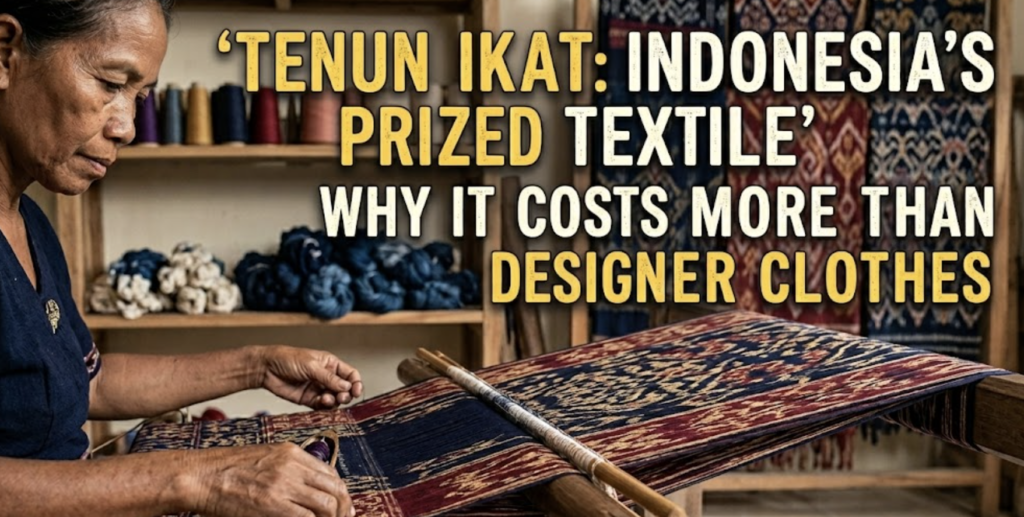
In the village on the island of Sumba, Indonesia, where this cloth was made, a woman spent the better part of two years producing it. She grew the cotton herself. She extracted the dye from plants she cultivated and foraged. She tied individual threads in specific patterns before dyeing — a process she repeated dozens of times to build the colors layer by layer. She wove the entire cloth on a backstrap loom, thread by thread, sitting on the floor of her home for hours each day.
Her daughter helped. Her mother taught her the patterns, which encode the cosmology and clan identity of their family, the same way her mother’s mother taught her, going back generations nobody alive can count.
The tourist who buys this cloth in the village market for forty dollars because it looks “nice and colorful” has no idea what they are holding.
This guide is for people who want to know.
What Is Tenun Ikat?
Tenun is the Indonesian word for weaving — specifically, fabric produced on a hand loom. Ikat comes from the Malay/Indonesian word mengikat, meaning “to tie” or “to bind.”
Tenun ikat is therefore tied weaving: a textile tradition in which the pattern is created not by manipulating threads during weaving, but by tying and dyeing the threads before they are put on the loom. The sections of thread that are tied resist the dye, creating undyed areas. After dyeing, the ties are removed and the threads are arranged on the loom in precise sequence so that the undyed and dyed sections align to form the intended pattern when woven.
This sounds straightforward. It is not.
For complex multi-color designs, each thread bundle must be tied, dyed, untied, re-tied in different configurations, and dyed again — sometimes dozens of times — before it is ready for the loom. The weaver must be able to visualize the final pattern in reverse, from the perspective of individual threads rather than the finished cloth, and execute the tying with the precision of a programmer writing code.
Then she has to weave it.
Where Is Tenun Ikat Made in Indonesia?
Indonesia has one of the richest and most diverse tenun ikat traditions in the world. Different islands and ethnic groups have developed distinct styles, patterns, and dyeing traditions over centuries.
Sumba (East Nusa Tenggara)
Sumba ikat — called hinggi for the large ceremonial cloths worn by men — is widely considered the most prestigious and valuable in Indonesia. The traditional patterns encode the Marapu ancestral belief system of the Sumbanese people: motifs of horses (symbol of nobility and the afterlife journey), royal animals, skulls, and geometric patterns that map clan lineage and spiritual cosmology.
Genuine traditional Sumba hinggi uses only natural dyes extracted from plants: nila (indigo) for blue-black, the root of the mengkudu (morinda) tree for rust red-orange, and various mordants to fix the colors. A single high-quality hinggi may take 18 months to 3 years to complete and represents one of the most labor-intensive textile traditions in the world.
Flores (East Nusa Tenggara)
Each district of Flores has its own distinct ikat tradition. The Ngada and Ende districts are particularly known for their ikat, often featuring bold geometric patterns in rust, black, and cream on hand-spun cotton. Flores ikat tends to be somewhat more accessible in price than Sumba work while still representing genuine craft tradition.
Nusa Tenggara Timur Generally
The broader NTT region — including the smaller islands of Rote, Sabu, and Alor — each has distinct ikat traditions with their own pattern vocabulary and color traditions. Collectors specifically seek out Rote and Sabu ikat for their refined geometric precision.
Lombok and Sumbawa
Lombok’s songket tradition (a related weaving form that incorporates supplementary metallic threads) is distinct from ikat but equally sophisticated. Some Lombok weavers also produce ikat.
Kalimantan (Borneo)
Dayak textile traditions include ulap doyo — a weaving made from the fibers of the doyo plant (Curculigo latifolia), unique to Borneo, with patterns that encode Dayak cosmology and clan identity.
How Tenun Ikat Is Made: The Process That Explains the Price
Understanding the production process is the fastest route to understanding why genuine tenun ikat costs what it costs — and why the $20 version at the tourist market is not the same thing.
Step 1: The Cotton
Traditional tenun ikat begins with hand-spun cotton — often grown locally, hand-cleaned, hand-carded, and spun on a drop spindle into thread. In Sumba, some weavers still practice the full process from raw cotton plant to finished cloth. This step alone — before any dyeing or weaving begins — can take weeks.
Step 2: The Natural Dye Preparation
Traditional dyes are extracted from plants through processes that can take days or weeks in themselves. Indigo leaves must be fermented. Morinda roots must be pounded, soaked, and processed with specific mordants. The dye bath must be maintained at the right temperature and pH. Some traditional dye processes require specific ritual conditions — certain activities are prohibited while the dye is prepared, because the dye process is understood to be spiritually sensitive.
Step 3: The Tying (Ikat)
This is the technical heart of the process. The warped threads are arranged in bundles and sections are tied with palm fiber or plastic (in modern practice) to resist the dye. For complex patterns, this tying must be extraordinarily precise — a mistake at this stage means a mistake in the final pattern that cannot be corrected.
Step 4: Dyeing
The tied threads are immersed in the dye bath, removed, allowed to oxidize (in the case of indigo), and the process is repeated. For multiple colors, the threads are partially untied, re-tied to protect the areas that have already been dyed, and immersed in the next color. This process may be repeated four, six, or eight times.
Step 5: Weaving
The dyed threads are mounted on the loom — traditionally a backstrap loom that the weaver controls with her own body tension — and woven thread by thread. For the pattern to emerge correctly, the warp threads must be arranged in exact sequence corresponding to the tying plan developed at the start. An error in arrangement at this stage means the pattern does not appear as intended.
The weaving itself proceeds at a pace of a few centimeters per day for complex patterns. A two-meter cloth can take months of weaving work after all the preparation is complete.
How to Tell Genuine Tenun Ikat from Tourist Imitations
The Indonesian tourist market is full of printed fabric sold as “ikat” — screen-printed or digitally printed imitations that can look convincing to an untrained eye. Here is how to tell the difference.
Look at the reverse side. Genuine woven ikat looks essentially the same on both sides — the pattern is structural, not applied to the surface. Printed fabric has a clearly faded or absent pattern on the reverse.
Look at the edges of the pattern. In genuine ikat, the edges of pattern motifs have a characteristic slight blur or feathering — a natural result of the resist-dyeing process, where the tied sections never achieve a perfectly crisp edge. This slight blurring is actually a mark of authenticity. Printed imitations have sharp, perfectly defined pattern edges.
Feel the texture. Hand-woven cloth on a backstrap loom has a distinctive irregular texture — slight variations in thread spacing and tension that create a subtle surface variation impossible to replicate mechanically. Factory-woven cloth feels perfectly uniform.
Check the price. A genuine traditional Sumba hinggi made with natural dyes and hand-spun cotton cannot realistically be sold for less than several hundred dollars and is typically worth significantly more. If someone offers you “authentic traditional ikat” for $15–$30, you are buying printed fabric.
How to Buy Ethically and Well
Go to the source. The best tenun ikat purchases happen in the weaving villages themselves — in Sumba, in the weaving communities around Flores, in the ikat villages of Lombok. Buying directly from the weaver means she receives the full price, not a fraction after passing through multiple resellers.
Ask about process. A genuine weaver will be happy to explain how her cloth was made, what patterns mean, and how long it took. This conversation also tells you whether you’re talking to someone who made the cloth or someone who bought it at wholesale to sell to tourists.
Be willing to pay appropriately. The most common mistake tourists make with tenun ikat is negotiating the price down as if it were a mass-produced souvenir. Haggling a weaver who spent 18 months on a cloth down from $150 to $80 is not a bargain — it is paying an artist less than minimum wage for their most skilled work. Pay what the work is worth.
Look for cooperative and certification labels. Several NGOs and cultural organizations work with Indonesian weaving communities to certify authentic handmade cloth and provide fair trade pricing. These include the Indonesian Textile Association and various regional craft cooperatives. Certified pieces come with documentation of their origin and process.
FAQ
Q: What is the difference between tenun ikat and batik?
A: Both are Indonesian textile traditions involving resist-dyeing, but the process is fundamentally different. Batik uses wax applied to already-woven fabric to create patterns through repeated waxing and dyeing. Tenun ikat creates patterns by tying and dyeing the threads before weaving. The result is that batik patterns sit on the surface of the cloth, while ikat patterns are structural — woven into the fabric itself.
Q: Can I bring tenun ikat home on a plane?
A: Yes, absolutely. Textile items are not restricted exports. Large cloths can be folded and packed in checked luggage or carried on. They make exceptional gifts and personal keepsakes — significantly more meaningful than typical tourist souvenirs and, if authentic, genuinely valuable objects.
Q: Where is the best place to buy tenun ikat in Indonesia?
A: For Sumba ikat specifically, the best sources are the weaving villages around Waingapu in East Sumba and the markets in Waikabubak in West Sumba. For a broader selection, the Sarinah department store in Jakarta has a curated collection of certified regional textiles. In Bali, the Threads of Life gallery in Ubud specializes in ethically sourced traditional Indonesian textiles with full provenance documentation.
Q: Is tenun ikat washable?
A: Cloth made with natural dyes should be washed by hand in cold water with gentle soap and kept out of direct sunlight when drying, as prolonged sun exposure can fade natural dyes. Synthetic-dyed versions are more colorfast but still benefit from gentle treatment.
Next read: [→ Why Indonesians Use Agarwood in Traditional Ceremonies]