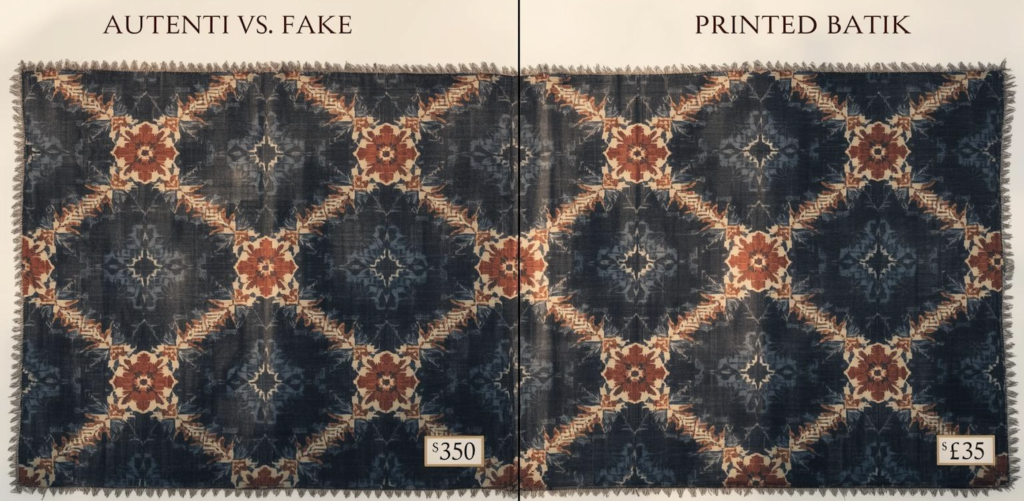
You are standing in a market stall in Yogyakarta. A shopkeeper unfolds a cloth in front of you — brilliant indigo blues, rust reds, cream-colored geometric patterns so intricate your eyes struggle to follow them. It is beautiful. It looks expensive. The shopkeeper says it is “traditional batik” and the price is $25.
Your instinct says something is wrong with this picture. Your instinct is correct.
Somewhere in Indonesia, there is a woman who spent three months creating a batik cloth using the exact same patterns you are looking at. She grew and processed natural dyes. She drew designs with hot wax using a copper tool called a canting — freehand, without stencils, requiring the precision of a surgeon. She waxed, dyed, and waxed again, building colors layer by layer. She then removed all the wax and finished the cloth.
Her work would sell for $300–$500 at a fair price.
The cloth in front of you — the $25 one — was probably made in a factory in East Java in an afternoon using digital printing and chemical dyes, then folded into the exact arrangement that suggests handwork.
This guide exists because that moment — standing in a market, holding two cloths that look identical but represent completely different realities — happens to thousands of tourists every year. Most never know the difference.
WHAT YOU’RE LOOKING AT: THE FUNDAMENTAL DIFFERENCE
Authentic hand-wax batik (also written wax-resist batik or true batik) is created by:
- Drawing a design directly onto fabric using hot wax applied with a small metal tool (the canting)
- Dyeing the cloth — the waxed areas resist the dye and remain undyed
- Removing the wax
- Repeating the process for each additional color
The pattern exists as part of the fabric structure. It is not applied to the surface.
Printed imitations (screen-printed, block-printed, or digitally printed) use:
- Photographic or digital technology to apply dye directly to the fabric surface
- Heat-setting to fix the dye
The pattern is applied to the surface, not woven into it.
This distinction matters because:
- Genuine batik is labor-intensive. A simple design takes days. Complex designs take weeks or months.
- Printed batik is mechanically efficient. Complex designs take hours.
- Genuine batik develops character over time — the cloth ages, colors shift, fibers soften.
- Printed batik stays exactly as it was when made.
The price difference reflects this reality, not snobbishness.
HOW TO TELL THE DIFFERENCE: FOUR TESTS YOU CAN DO IN A MARKET
TEST 1: LOOK AT THE BACK
This is the fastest and most reliable test.
Genuine wax-resist batik: The pattern is essentially identical on both sides of the cloth. It is structural — the resist-dyeing creates the pattern throughout the fabric thickness, not just on the surface. When you flip a genuine batik cloth over, you should see the same design, with the same colors, in the same positions.
Printed batik: The reverse side will show either a faded version of the pattern or none at all. The pattern is printed on the surface only. Some printed batiks show a reverse pattern with all colors significantly muted or washed out. This is a dead giveaway.
How to do this in a market: Ask the shopkeeper if you can see the back of the cloth. If they hesitate or seem concerned about you examining it closely, this tells you something. Authentic sellers are proud of the reversibility.
TEST 2: LOOK AT THE PATTERN EDGES
In genuine batik, the edges of the pattern have a characteristic slight blur or feathering. This is the natural result of the wax-resist process — the wax edges are not perfectly rigid, so the dye bleeds slightly into the tied regions at the boundary. This creates a soft, slightly fuzzy edge on every pattern element.
This blurring is actually a marker of authenticity. It is impossible to achieve with screen printing or digital printing, which produce sharp, perfectly defined edges.
Printed batik has crisp, perfectly sharp edges on every pattern element. Every line is clean. Every corner is exact. It looks mechanical because it is mechanical.
How to do this in a market: Look at the borders of major pattern elements. Put your face close (it’s okay, the shopkeeper expects this). Run your finger along the edge. Genuine batik edges feel slightly irregular. Printed batik edges feel sharp.
TEST 3: FEEL THE TEXTURE
Hand-woven cloth made with traditional tools has a characteristic irregular texture. A backstrap loom or hand-loom cannot produce perfectly uniform fabric. The thread spacing varies slightly. The tension shifts subtly. The surface has micro-variations that create a subtle tactile variation.
When you run your hand across genuine batik cloth, you feel these variations. The surface is not perfectly smooth. It has what textile people call “irregularity.”
Factory-produced cloth, including printed batik, is woven on industrial looms that maintain perfect mechanical consistency. The fabric feels perfectly uniform. No variation.
How to do this: Close your eyes and feel the cloth. Genuinely handmade textiles have a subtle textural variation that you can feel even with your eyes closed. Mechanically produced cloth feels uniform.
TEST 4: CHECK THE PRICE ANCHOR TO REALITY
If someone is offering you “authentic traditional batik” for $15–$35, you are buying printed fabric.
Here is the actual time investment:
- Complex traditional batik design: 60–120+ hours of labor (canting work alone)
- Even simple batik: 20–40 hours of labor minimum
- In Indonesia, where labor is less expensive than the West, minimum wage ranges from $4–$8 per day. A batik worker earning a reasonable wage would cost $40–$100 just in wages for a single cloth, before materials, tools, workspace, and the unsold pieces that didn’t sell.
A genuinely handmade traditional batik cloth cannot realistically sell for less than $150 and is typically worth more. If the price seems too good to be true, it is.
Exception: Some modern batik makers use pre-drawn designs (reducing design time) and simplified techniques. These are still hand-wax, still authentic, and can be less expensive than fully traditional work. But they are still unlikely to be $20.
REGIONAL VARIATIONS: WHY GENUINE BATIK DIFFERS BY LOCATION
Different regions of Java and Indonesia developed distinct batik traditions over centuries. Knowing these helps you understand what you’re looking at.
JAVANESE BATIK (The Classic)
From Central Java (Solo, Yogyakarta), Javanese batik features:
- Intricate geometric and naturalistic patterns (wings, flowers, spirals)
- Often jewel tones: deep indigo, rust red, cream, black
- Natural dyes (indigo from leaves, red from madder, brown from tannins)
- Very fine detail work — requires exceptional skill
- Most expensive and most prized
Where to buy: Directly from batik makers in Solo or Yogyakarta. Markets like Pasar Beringharjo in Yogyakarta.
COASTAL BATIK (Pekalongan, Cirebon)
From coastal Java towns, coastal batik features:
- Influence from Chinese, Dutch, and Arab traders — more diverse color palettes
- Often incorporates imported motifs (dragons, florals from international trade)
- Slightly more accessible pricing than Javanese batik
- Still authentic hand-wax work but often faster-paced designs
MODERN BATIK
Some contemporary Indonesian batik makers are experimenting with:
- Non-traditional colors (using chemical dyes instead of only natural dyes)
- Contemporary designs while maintaining hand-wax technique
- Faster production (simplified designs but still handmade)
This is still genuine batik. It is just not “traditional” batik. Both have value — just different values.
WHERE TO BUY AUTHENTIC BATIK (AND WHERE NOT TO)
WHERE TO BUY GENUINE BATIK:
Batik maker cooperatives and workshops
- Yogyakarta: Numerous batik workshops in the city center
- Solo: The batik-making villages of Laweyan
- Pekalongan: Coastal town famous for batik heritage
You visit the maker, see the work being made, buy directly. You pay full price. The maker gets full price. This is fair.
Cooperative shops and certified retailers
- The Sarinah department store in Jakarta has curated batik sections
- Threads of Life gallery in Ubud, Bali (specializes in ethical Indonesian textiles)
- Various NGO-affiliated cooperative shops that certify authentic work
Markets (with caution)
- Pasar Beringharjo in Yogyakarta has genuine batik stalls — but you must know how to identify it
- Ask the seller: How long did this take to make? Can you tell me the process? Is this your work or wholesale?
- Genuine sellers have detailed knowledge. Resellers do not.
WHERE NOT TO BUY:
- Tourist-oriented shops in Bali and Jakarta selling batik for under $30
- Airport shops selling “batik”
- Generic souvenir markets selling mass-produced cloth
FAQ
Q: Is all cheap batik in markets definitely fake?
A: Probably. It is possible to find authentic batik made with simplified designs at lower prices, but it is rare. If it seems impossibly cheap, it is.
Q: Can I tell if batik is authentic just by looking at photos online?
A: Not reliably. The back-side and texture tests require physical examination. Buy batik in person, or buy from certified sellers with returns policies.
Q: Is printed batik “bad”? Should I never buy it?
A: Printed cloth is fine if that is what you want — it can be beautiful and is much more affordable. The issue is honesty. If a seller calls it “authentic traditional batik” when it is printed, that is deceptive. If they say “This is a printed batik-style cloth,” that is honest marketing.
Q: Will authentic batik fade or change color if I wash it?
A: Cloth made with natural dyes will fade slowly over years with repeated washing and sun exposure. This is normal and many people appreciate the aging process. Machine-wash on gentle, use cold water, avoid direct sunlight for drying.
Q: What is the difference between batik and ikat?
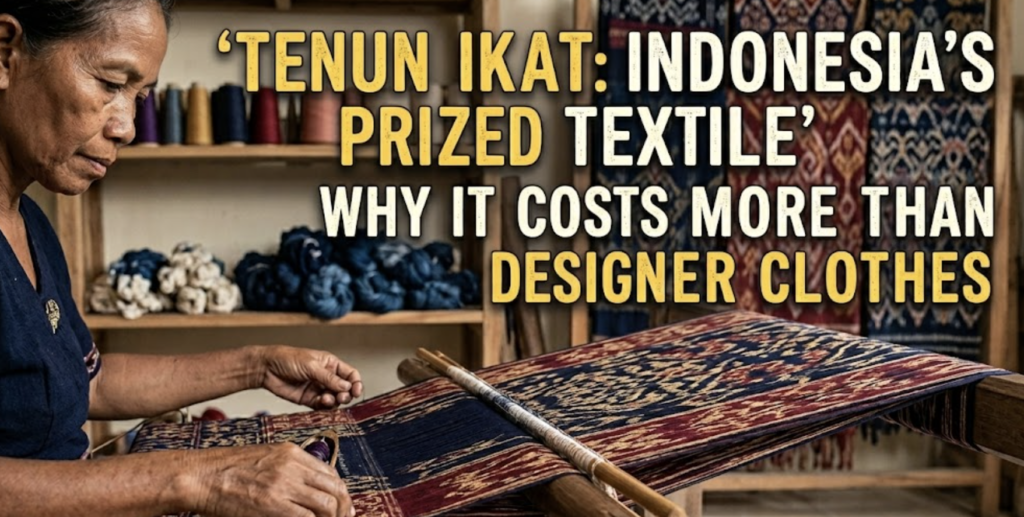
A: Both are resist-dye traditions but fundamentally different. Batik uses wax on already-woven fabric. Ikat ties threads before weaving. Batik patterns are on the surface; ikat patterns are structural.