Your stomach is uncomfortable. You have eaten something too rich, or too much, or something your body doesn’t recognize. Your digestion has stalled.
In Java, in this moment, you would walk out your front door early in the morning and wait. Within an hour, a woman would pass by carrying a wooden basket balanced on her back. The basket would contain perhaps six or seven glass bottles filled with liquids in different shades — some clear and yellow, some dark brown, some an unsettling black.
You would recognize her. She comes the same time every morning. You would flag her down. She would pour you a small glass of whatever your particular concern calls for.
If your issue is digestion, she would pour the yellow liquid: jamu kunyit asem — turmeric and tamarind jamu. You would drink it in one or two gulps. It tastes like something between a spice and a medicine, which is accurate because it is both.
Your digestion would improve within hours.
This is not because you believed it would. It is because the herbal formula has been refined over more than a thousand years to do exactly this.
WHAT JAMU KUNYIT ASEM IS
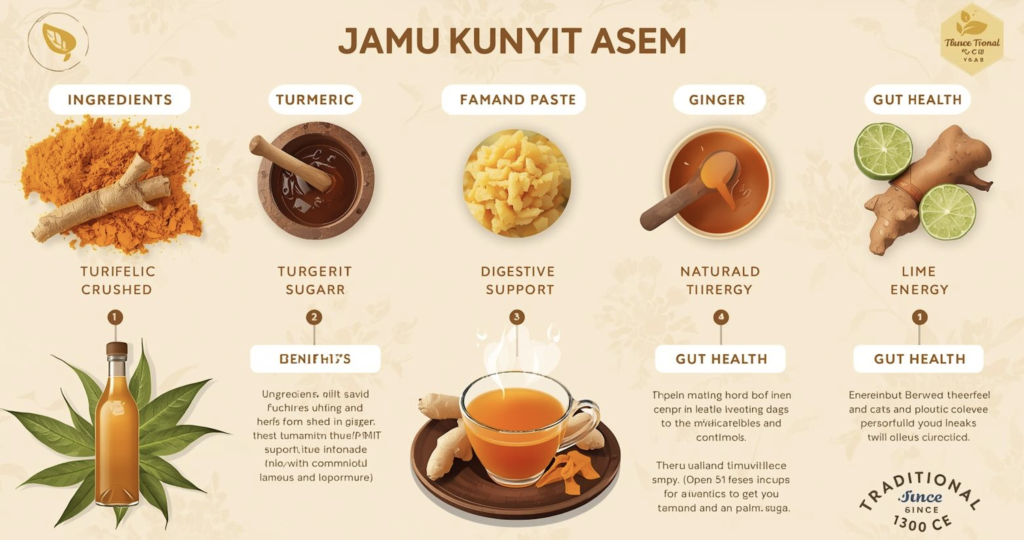
Jamu kunyit asem literally means “turmeric sour jamu” — referring to its two primary active ingredients: turmeric (kunyit) for anti-inflammatory action and tamarind (asem) for digestive stimulation.
The full formula typically includes:
Primary Ingredients:
- Kunyit (Turmeric root) — The foundational ingredient for inflammation and digestion
- Asem (Tamarind paste) — Stimulates digestive acids and adds beneficial sour taste
- Gula Jawa (Palm sugar) — Balances the intense bitter/sour flavors, adds natural sweetness
Secondary Ingredients (vary by maker):
- Jahe (Ginger) — Enhanced circulation
- Kencur (Aromatic ginger) — Reduces bloating
- Temulawak (Javanese turmeric) — Additional liver and digestive support
- Lemon or lime juice — Additional citric acid for digestive stimulation
The exact formula varies by region and by individual maker. Some families have proprietary variations passed down through generations. What unites them is the core: turmeric, tamarind, and palm sugar.
WHY THESE INGREDIENTS WORK: THE SCIENCE BEHIND THE TRADITION
TURMERIC (KUNYIT): THE ANTI-INFLAMMATORY FOUNDATION
Turmeric contains curcumin, a compound that has been extensively studied in modern pharmacology and repeatedly demonstrated to reduce inflammation throughout the digestive tract.
What it does:
- Reduces inflammation in the stomach lining
- Decreases intestinal permeability (stops the “leaky gut” mechanism)
- Stimulates bile production, which improves fat digestion
- Protects stomach lining from excessive acid
This is not traditional knowledge claiming something. This is established pharmacological fact. Turmeric is so well-documented that it is the subject of over 10,000 peer-reviewed scientific studies.
The Javanese knew this worked for 1,300 years before Western science had the technology to explain why.
Dosage in traditional jamu: Approximately 1–2 grams of fresh turmeric root per serving (or about 0.5 grams of dried powder).
TAMARIND (ASEM): THE DIGESTIVE STIMULANT
Tamarind is a tropical fruit with an intensely sour taste due to its high content of malic acid, citric acid, and tartaric acid.
What it does:
- Stimulates saliva production (digestion begins in the mouth)
- Increases stomach acid production, preparing the stomach to process food
- Acts as a natural laxative, improving intestinal motility
- Contains polyphenols with antioxidant and anti-inflammatory properties
The sour taste is not incidental to the medicine — it is part of the mechanism. Your mouth’s response to sourness is literally the beginning of enhanced digestion.
Dosage in traditional jamu: Approximately 2–3 tablespoons of tamarind paste per serving.
PALM SUGAR (GULA JAWA): THE BALANCING AGENT
Palm sugar serves multiple functions:
- Flavor balance: The bitter intensity of turmeric and sour intensity of tamarind would be unpleasant without sweetness to round them
- Energy provision: Simple carbohydrates that provide quick energy without requiring extensive digestion
- Prebiotic function: Unrefined palm sugar contains minerals and compounds that feed beneficial gut bacteria
Modern “superfood” culture would call this “prebiotic,” but it has been understood functionally in Java for centuries.
Dosage in traditional jamu: Approximately 1–2 tablespoons of palm sugar per serving.
THE JAMU MAKER’S PROCESS: HOW IT IS TRADITIONALLY PREPARED
Traditional jamu makers prepare their formulas fresh every day, before dawn.
STEP 1: SOURCING INGREDIENTS
The best jamu makers grow or source from growers they know. Fresh turmeric root. Fresh tamarind paste (or in season, fresh tamarind fruit). Fresh ginger if it is part of their formula.
Some use dried ingredients if fresh are unavailable, but traditionally the ingredients are as fresh as possible.
STEP 2: PREPARING THE TURMERIC
Fresh turmeric root is peeled and crushed using a mortar and pestle or traditional grinding stone. The crushing breaks down cell walls and releases the active compounds.
In some traditional methods, the crushed turmeric is heated gently — not boiled, but warmed to extract more fully — then strained.
STEP 3: COMBINING WITH TAMARIND AND SUGAR
The tamarind paste is mixed with palm sugar and water to create a concentrated sweet-sour base. The crushed turmeric is added to this mixture.
The proportions vary, but a traditional ratio might be:
- 1 part turmeric (crushed)
- 2 parts tamarind paste
- 1.5 parts palm sugar
- 3–4 parts water
The mixture is stirred thoroughly.
STEP 4: BOTTLING AND STORAGE
The jamu is poured into small glass bottles. It is not boiled or pasteurized in traditional preparation — this would destroy some of the beneficial compounds. It remains viable for several days at room temperature, longer if refrigerated.
The jamu gendong carries her bottles in an insulated basket and sells throughout her morning rounds.
MAKING JAMU KUNYIT ASEM AT HOME: A PRACTICAL RECIPE
If you want to experience this at home, either in Indonesia or after returning, the recipe is straightforward.
INGREDIENTS (Makes approximately 1 serving):
- 1–2 inches fresh turmeric root (or 1 teaspoon dried turmeric powder)
- 2 tablespoons tamarind paste (or juice from 3–4 fresh tamarind pods)
- 1–2 tablespoons palm sugar (or coconut sugar as substitute)
- 1 cup water
- Optional: 0.5 inch fresh ginger, 0.5 teaspoon kencur powder, juice from half a lime
INSTRUCTIONS:
If using fresh turmeric:
- Peel the turmeric root and crush it roughly with the side of a knife
- Bring the water to a gentle boil and add the crushed turmeric
- Simmer for 3–5 minutes (not a rolling boil — a gentle heat)
- Remove from heat and let sit for 2–3 minutes
- Strain out the turmeric pieces
If using dried turmeric powder:
- Bring water to boil
- Add turmeric powder and remove from heat
- Let it sit for 2–3 minutes
- The powder will eventually settle to the bottom; you can drink it or strain it
Completing the jamu:
- While still warm (but not hot enough to burn your mouth), add the tamarind paste and palm sugar
- Stir thoroughly until sugar dissolves
- Add fresh ginger, kencur, or lime if using
- Drink it warm or at room temperature
Taste expectation: It should taste distinctly spiced, noticeably sour, and naturally sweet. It is not meant to taste pleasant in a dessert way — it is meant to taste like medicine, which it is.
DOSAGE AND TIMING:
Traditional practice is to drink jamu kunyit asem:
- In the morning on an empty stomach for general digestive support
- After a heavy meal if digestion feels sluggish
- Once daily as a maintenance dose for people with chronic digestive sensitivity
Do not drink it more than once daily. The acids can wear on tooth enamel if consumed excessively.
WHEN JAMU KUNYIT ASEM WORKS BEST
Conditions it effectively addresses:
- Sluggish digestion after heavy meals
- Bloating and gas
- General stomach inflammation
- Sluggish metabolism
- Early-stage food sensitivities
Conditions where it helps but is not sufficient:
- Severe acid reflux (may need additional treatment)
- Acute gastroenteritis (may need more aggressive intervention)
- Chronic inflammatory bowel conditions (supportive but not curative)
If you have serious digestive issues, jamu is a support, not a replacement for medical care.
WHERE TO FIND JAMU KUNYIT ASEM IN INDONESIA
From a jamu gendong: Walk the streets of Yogyakarta, Solo, or any Javanese city in the early morning and you will find them. Stop one. Ask for “jamu kunyit asem.” Cost: approximately 2,000–5,000 IDR (about $0.15–$0.30 USD).
In traditional markets: Pasar Beringharjo in Yogyakarta or similar traditional markets in Java have jamu stalls where you can try multiple formulas.
Bottled commercial versions: If you want to bring jamu home, brands like Sido Muncul, Jamu Jago, and Nyonya Meneer produce bottled jamu kunyit asem available in supermarkets throughout Indonesia. These are shelf-stable and travel well. Quality is decent, though not the same as fresh-made.
FAQ
Q: Can I drink jamu kunyit asem every day?
A: Yes, many Indonesians do. Once daily is the traditional dose. More than once daily is not recommended due to the acid content.
Q: Will jamu stain my teeth?
A: Turmeric can stain teeth slightly over time with very frequent consumption. Rinse your mouth after drinking or use a straw.
Q: Is jamu safe during pregnancy?
A: Turmeric in food amounts is generally safe. However, medicinal amounts of turmeric during pregnancy are sometimes contraindicated. Ask a healthcare provider if pregnant.
Q: Does jamu need to be refrigerated?
A: Freshly made jamu will keep at room temperature for 24 hours, longer if refrigerated. Commercial bottled jamu is shelf-stable.
Q: Can I use turmeric supplements instead of fresh jamu?
A: Supplements are convenient but lack the additional compounds in the whole plant preparation. Fresh jamu is more effective, but supplements are better than nothing.