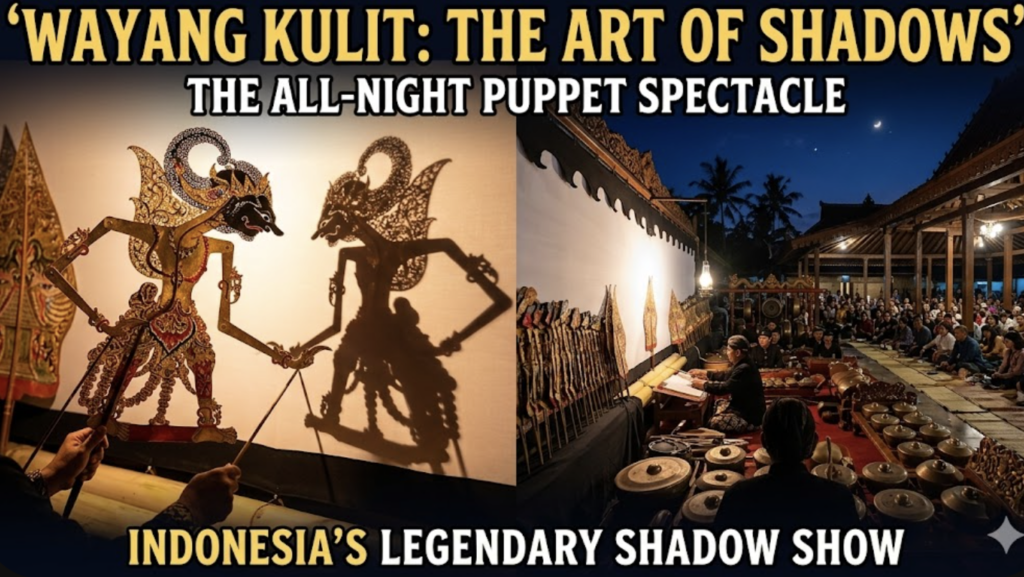
The performance begins at nine in the evening. It ends at five in the morning.
One man — the dalang, the puppeteer — will voice over two hundred characters, operate hundreds of leather puppets, conduct a full gamelan orchestra behind him using only foot signals, and narrate an eight-hour story drawn from the Hindu epics Mahabharata and Ramayana. Told, of course, in the Javanese way — which means the philosophy, the jokes, and the political commentary are entirely Indonesian.
By midnight, most of the audience is asleep.
This is fine. This is expected. This is, in some ways, the point.
Wayang kulit is not entertainment the way a Western theatrical performance is entertainment. It is a ritual — a ceremony of cultural transmission, spiritual protection, and communal gathering that has been performed continuously in Java and Bali for over a thousand years. The sleeping audience is not failing to appreciate it. They are participating in it.
What Wayang Kulit Actually Is
Wayang is the Javanese word for shadow, performance, puppet — the word encodes the philosophy of the entire tradition. Kulit means leather or skin.
The puppets are flat figures made from intricately perforated and painted buffalo leather, manipulated behind a white cloth screen called the kelir, with a lamp casting their shadows onto the surface. The audience can watch from either side — facing the screen to see the shadows, or facing the dalang to watch the puppeteer work.
The visual language is immediately distinctive. The figures are not realistic. Noble characters have refined, downward-angled faces. Villainous characters have upward-angled, broader features. Body color, eye shape, nose size, and costume are codes that any Javanese audience reads instantly: hero, clown-servant, demon king. A visual grammar that took centuries to develop and still functions today.
The Dalang: One Person, the Entire Universe
The dalang is one of the most remarkable performance specialists in any cultural tradition anywhere.
He must voice dozens of distinct characters — each with their own register, speech pattern, and emotional range. He must narrate, sing, joke, philosophize, and deliver political commentary simultaneously. He must operate multiple puppets at once while conducting the gamelan with his feet and signaling specific musical pieces through coded gestures.
He must know the entire story cycle of the Mahabharata and Ramayana and be able to improvise new narratives within the traditional framework — drawing the ancient mythology into dialogue with current events, local politics, community concerns.
And he must sustain this for eight hours without stopping.
Training begins in childhood and continues for decades. The most respected dalang are considered living cultural treasures. Some are officially recognized by the Indonesian government as such.
Why It Runs All Night
The duration is not arbitrary. It is the entire logic of the form.
The performance mirrors the journey of human life. Birth at the beginning of the night. Growth and conflict through the middle hours. Resolution and wisdom as dawn approaches. The audience that falls asleep in the middle and wakes to see the ending has experienced the full arc — which is, the Javanese would point out, exactly how most people move through their own lives.
The ending — arriving around 3–5 AM as light begins to show — traditionally involves the defeat of chaos and the restoration of cosmic order. The gunungan — the mountain puppet that represents the cosmos — is placed center-screen. The dalang delivers a closing prayer. The gamelan plays the final piece.
And the village disperses into the morning. The protective ritual is complete.
Where to See It as a Tourist
Wayang kulit performances happen around community events — marriages, circumcisions, births, harvests, the cleaning of sacred objects. They also happen for the anniversaries of the royal palaces in Yogyakarta and Solo.
Yogyakarta: The Sonobudoyo Museum runs a shortened tourist-accessible wayang kulit performance most evenings — about two hours rather than eight, but authentically staged. A good introduction.
Solo (Surakarta): The RRI — Radio Republik Indonesia — holds regular all-night wayang kulit broadcasts that are real performances, not staged for visitors. Respectful attendance is sometimes possible.
Village performances: If you’re staying in rural Central or East Java and you hear gamelan starting after dark, you are almost certainly welcome to sit and watch as a quiet observer. Bring a sarong. Stay as long as you can manage.
FAQ
Q: Is wayang kulit only Javanese? A: No. Wayang traditions exist across Indonesia — Balinese, Sundanese, Batak, each with distinct visual languages and story cycles. Javanese wayang kulit is the most internationally known, but the broader wayang family is archipelago-wide.
Q: Are the stories always from the Hindu epics? A: Traditionally yes — the Mahabharata and Ramayana form the primary cycle. But skilled dalang have always woven in local mythology, Islamic narratives, and contemporary commentary. The ancient framework is the container. What goes inside it evolves constantly.
Q: Can I commission a performance? A: Yes. Families commission wayang for significant life events. A full overnight performance with a respected dalang and full gamelan orchestra is a meaningful community event — not cheap, but not a tourist package either. Ask through cultural contacts in Yogyakarta or Solo.
Next read: → The Lost Kingdom of Srivijaya: Where Did Indonesia’s Greatest Empire Disappear?