There are approximately seven pink-sand beaches in the entire world. Most are remote, difficult to reach, and quietly extraordinary. One of them sits inside a national park patrolled by the largest living reptile on earth.
That one is worth talking about.
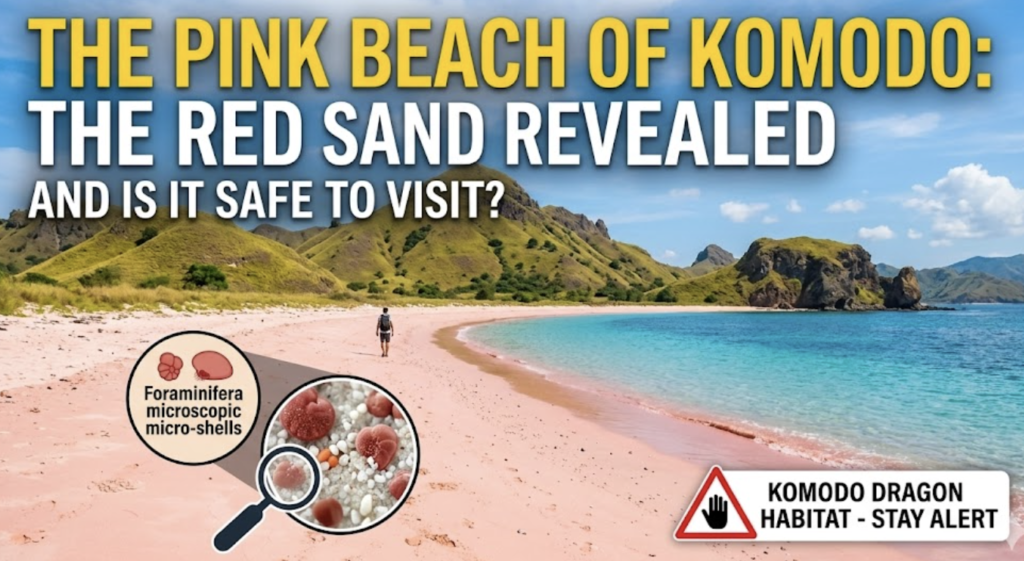
Pantai Merah — “Red Beach” in Indonesian, though the world knows it as Pink Beach — is located on Komodo Island in Nusa Tenggara Timur, within the boundaries of Komodo National Park. It is not pink the way a sunset is pink, or the way a flamingo is pink. It is a deep, dusty, unmistakably geological pink — the kind of color that makes you look twice because your brain insists sand should not be this color.
And the reason it is this color is stranger and more beautiful than most visitors ever learn.
Why Is the Sand Pink? The Real Science
The sand at Pantai Merah is not dyed, altered, or the result of any mineral deposit in the beach itself. It is pink because of what lives — and dies — in the water offshore.
The culprit is a microscopic organism called Foraminifera — specifically a species whose shell, when alive, is a vivid red-pink color. Foraminifera are single-celled marine organisms that build intricate calcium carbonate shells around themselves. They are extraordinarily abundant in healthy coral reef ecosystems — which the waters around Komodo Island very much are.
When Foraminifera die, their shells sink to the seafloor. Wave action gradually breaks these shells into fine particles and washes them onto the beach, where they mix with the white calcium carbonate of broken coral and shell fragments. The resulting blend is sand with a distinctly pink-red tint — the precise shade depending on the concentration of Foraminifera fragments relative to white coral sand.
The shade of pink at Pantai Merah is therefore a direct indicator of reef health. A thriving Foraminifera population means a healthy reef ecosystem means more pink sand. If the reef were damaged — by bleaching, pollution, or physical destruction — the pink would gradually fade as the supply of red shell fragments diminished.
In this sense, Pantai Merah’s color is a living reef health report. It is beautiful precisely because the ecosystem producing it is still functioning.
Where Exactly Is Pink Beach?
Pantai Merah is located on the eastern coast of Komodo Island, one of the main islands within Komodo National Park. The park encompasses Komodo Island, Rinca Island, Padar Island, and dozens of smaller islands spread across the Flores Sea.
The beach is not reachable by road — there are no roads on Komodo Island beyond the immediate area of the ranger station and village. Access is by boat only, which means Pink Beach is always visited as part of a boat-based tour of the national park.
From Labuan Bajo (the main gateway town on Flores, reached by flight from Bali, Lombok, or other Indonesian hubs): day trips and overnight liveaboard trips into the park depart daily. Pink Beach is a standard stop on most Komodo National Park itineraries.
Journey time by boat: approximately 2–3 hours from Labuan Bajo to Komodo Island, depending on boat speed and sea conditions.
Is It Safe to Visit? The Komodo Dragon Factor
This is the question every visitor eventually asks, and it deserves a direct answer: yes, with the right precautions and the mandatory ranger accompaniment.
Komodo dragons (Varanus komodoensis) are present throughout Komodo Island, including in the areas around Pantai Merah. They are not confined to specific zones, do not recognize tourist areas as off-limits, and are perfectly capable of moving between the beach area and the surrounding forest.
However, Pantai Merah is a regularly visited site with ranger presence. The beach is not in a dense jungle area where dragons could approach unseen — it is an open beach with good visibility. Ranger guides accompany all visitor groups on the island.
The precautions are the same as anywhere in Komodo National Park:
- Never walk away from your ranger guide, even briefly
- Do not leave the beach area into the surrounding vegetation unaccompanied
- Keep your distance from any dragon you encounter — minimum 3–5 meters
- Do not bring food onto the beach or eat in ways that might attract attention
- Do not approach a dragon for a photo, no matter how still and calm it appears
One additional beach-specific caution: do not snorkel or swim far from the shore without checking current conditions first. The waters around Komodo Island are renowned for strong, unpredictable currents. The underwater terrain is extraordinary for divers and snorkelers — but the currents that make the ecosystem so rich also make the water dangerous for anyone who doesn’t respect them. Always ask your boat captain or ranger about current conditions before entering the water.
The Snorkeling and Diving: Why It’s Worth the Trip
If the pink sand were the only attraction, Pantai Merah would still be worth the journey. But the real extraordinary thing about this beach is what happens when you put your face in the water.
The reef immediately offshore from Pantai Merah is one of the healthiest in Indonesia — which means one of the healthiest in the world. The strong currents that flow through the Komodo National Park waters carry cold, nutrient-rich upwellings from the deep ocean, feeding an underwater ecosystem of extraordinary density and diversity.
What you can expect to see:
In the shallows directly off the beach: dense coral gardens, schools of reef fish in numbers that border on overwhelming, sea turtles moving through the coral with complete indifference to human observers, and — if you look carefully at the sand between coral heads — the Foraminifera themselves, alive and red, the very organisms responsible for the pink beach above.
In the deeper waters accessible to divers: manta rays are frequently encountered in the park’s waters, particularly at nearby cleaning stations. Reef sharks patrol the outer edges of the reef. Occasional sightings of whale sharks have been reported. The fish biomass in these waters is among the highest recorded anywhere in the Indo-Pacific.
When to Visit: Timing Your Trip
Best season: April to December, with July–September being the peak dry season offering the calmest seas, best visibility, and most predictable boat crossings. The beach and water are accessible year-round, but January–March brings rougher seas that can make the crossing from Labuan Bajo uncomfortable and occasionally dangerous on smaller boats.
Best time of day at the beach: Morning. By mid-afternoon, the beach can become crowded with day-trip boats from Labuan Bajo. Arriving early — which means departing Labuan Bajo before sunrise on a liveaboard or very early day trip — gives you the beach in near-solitude, the best light for photography, and calmer sea conditions for snorkeling.
Avoiding crowds: Liveaboard dive trips that spend multiple nights in the park typically visit Pink Beach early in the morning before day-trip boats arrive. For a Pink Beach experience without 200 other tourists, a liveaboard is strongly worth the additional cost.
Protecting What Makes It Pink
Pantai Merah’s color depends entirely on the health of its reef ecosystem. This makes it unusually vulnerable to the standard forms of tourist damage that affect beaches worldwide.
Do not stand on or touch the coral. This applies everywhere in Komodo National Park, but at Pink Beach specifically, the Foraminifera that create the pink sand live in and around the reef structure. Physically damaging the reef reduces the population of organisms that produce the beach’s color.
Do not collect sand or shell fragments. This seems obvious but happens constantly. The pink sand is not a souvenir to take home — it is an active geological process. Every handful removed is a small subtraction from what makes this place extraordinary.
Use reef-safe sunscreen. Standard sunscreen formulations contain chemicals that are demonstrably harmful to coral reef ecosystems. Reef-safe options (mineral-based, without oxybenzone and octinoxate) are available in Labuan Bajo and are required practice for responsible reef visitors worldwide.
FAQ
Q: How many pink beaches are in the world?
A: The exact number depends on how you define “pink” — estimates range from 7 to 21 globally, depending on whether you include beaches with subtle pinkish tints or only those with unmistakably pink coloration. The most famous include Harbour Island in the Bahamas, Elafonissi in Crete, and Pantai Merah in Indonesia.
Q: Is there an entrance fee for Komodo National Park?
A: Yes. Entry fees for Komodo National Park are set by the Indonesian government and have changed several times in recent years. As of recent updates, fees for foreign tourists are significantly higher than for domestic visitors. Check current rates with your tour operator in Labuan Bajo, as these figures change and any price I give here may be outdated.
Q: Can I camp on Pink Beach overnight?
A: Camping on Komodo Island beaches is not permitted for safety reasons — primarily the presence of Komodo dragons, which are active at night. Liveaboard boats anchored offshore are the closest you can get to an overnight Pink Beach experience.
Q: What’s the best way to photograph Pink Beach?
A: The pink color is most visible and saturated in the soft light of early morning and late afternoon. Midday sun tends to wash out the color and make the sand look more beige than pink. A polarizing filter for your camera reduces glare from the water and helps the pink tones read more clearly in photographs.
Next read: [→ Local Village Rules for Taking Pictures with Komodo Dragons]